 Sumit Yadav
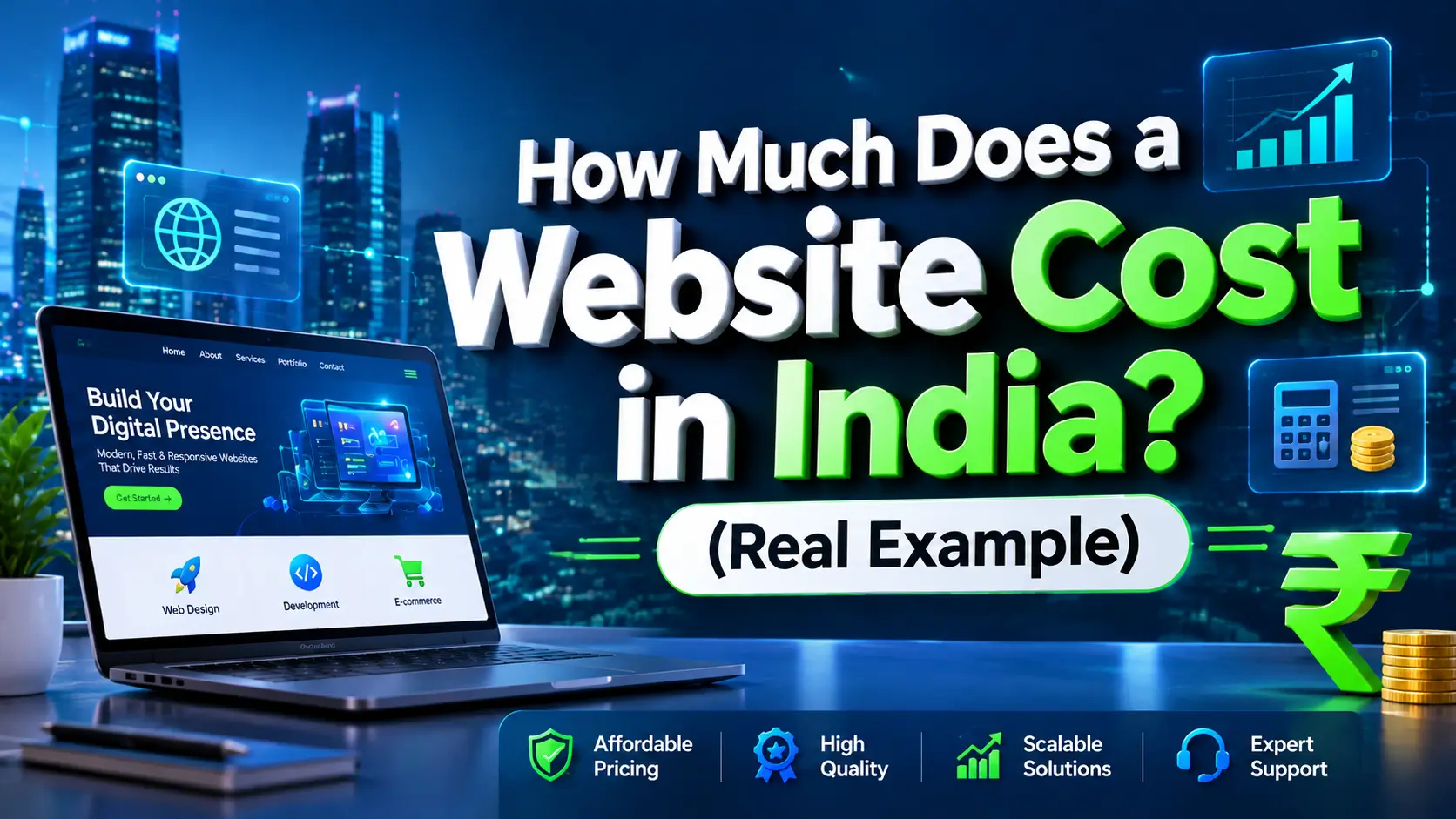
A professionally engineered website developed in India in 2027 typically costs between $800 and $2,500 for a standard corporate website, $2,500 to $7,500 for an ecommerce storefront, and $6,000 to upwards of $25,000 for a complex web application or software-as-a-service minimum viable product. The final cost depends on user interface customization, underlying system architecture, third-party software integrations, and whether you hire an independent freelancer, an established agency, or a dedicated developer pod. For international businesses and agency owners, outsourcing technical delivery to India reduces operational capital requirements while providing access to scalable full-stack engineering talent.
Key Takeaways
- Corporate Builds: Simple brochure and lead-generation websites cost between $800 and $2,500 (approx. ₹65,000 to ₹2,00,000) with a delivery window of two to four weeks.
- Ecommerce Investments: Modern online stores deployed on Shopify or WooCommerce range from $2,500 to $7,500, with enterprise setups requiring larger integration budgets.
- Hourly Rate Benchmarks: Agency hourly billing in India ranges from $20 to $45 per hour, contrasting with $65 to $150 or more in Western markets.
- Zero-Rated Export GST: Overseas clients paying Indian agencies in convertible foreign exchange qualify for 0% Goods and Services Tax (GST) under a valid Letter of Undertaking (LUT), avoiding the 18% domestic tax.
- Ongoing Ownership Costs: Routine hosting, domain renewals, security updates, and software licensing add an estimated 15% to 20% of the initial project budget each year.
What Determines Website Development Pricing in India?
Website development quotes in India span a broad spectrum because the term “website” encompasses everything from a templated WordPress setup to an enterprise-grade cloud application. Several architectural and operational variables drive these figures:
- User Interface and Experience Design: Templated layouts adapted with minor styling require minimal front-end engineering. Conversely, bespoke user interfaces designed from scratch in Figma—incorporating custom design systems, responsive micro-interactions, and accessibility standards—require dedicated design and front-end implementation phases.
- Architecture and CMS Selection: Open-source content management systems reduce initial capital expenditure. However, organizations evaluating a custom website vs WordPress build must weigh setup speed against long-term maintenance, security overhead, and custom database requirements.
- Data Flows and Integrations: Connecting a site to third-party customer relationship management (CRM) software, payment gateways, enterprise resource planning (ERP) systems, or multi-carrier logistics APIs increases testing and development time.
- Partner Delivery Model: Independent freelancers offer lower hourly pricing but generally lack dedicated quality assurance (QA) engineers, DevOps architects, and project managers. Agencies provide multi-tiered project oversight that prevents technical debt.
At NetClubbed, the single biggest driver of scope creep we see is integration complexity that wasn’t visible at the quoting stage — a client asks for “CRM sync” assuming it’s a checkbox, but once we’re in discovery we find their CRM has custom fields, legacy data formats, or multiple pipelines that each need separate mapping logic. We’ve learned to run a short, paid discovery sprint before quoting anything with third-party integrations, because guessing at that complexity upfront is what causes a $3,000 estimate to become $6,000 mid-project.
2027 Website Cost in India: Breakdown by Project Type
To establish predictable budgets, development projects can be classified into four primary categories based on technical scope, functional complexity, and project delivery timelines.
1. Brochure and Corporate Websites (5 to 10 Pages)
- Typical Cost: $800 – $2,000 (approx. ₹65,000 – ₹1,65,000)
- Timeline: 2 to 4 weeks
- Ideal For: Professional service firms, consultants, and local businesses requiring an authoritative online presence.
This tier covers clean informational websites built to establish credibility and capture inbound inquiries. Typical deliverables include a customized WordPress or lightweight static front-end, mobile-responsive layouts, conversion-focused contact forms, analytics tracking, and foundational on-page search engine optimization (SEO).
2. Growth-Oriented CMS and Lead-Generation Sites (15 to 30 Pages)
- Typical Cost: $2,000 – $5,000 (approx. ₹1,65,000 – ₹4,10,000)
- Timeline: 4 to 8 weeks
- Ideal For: Mid-market B2B organizations, regional service providers, and established brands scaling content marketing.
Mid-market builds demand bespoke Figma UI designs, custom post types, dynamic filtering, structured content authoring, and two-way CRM sync (such as HubSpot or Salesforce). Performance optimization is crucial at this tier to guarantee rapid load speeds and healthy Google Core Web Vitals.
3. E-Commerce Platforms (Shopify and WooCommerce)
- Typical Cost: $2,500 – $7,500 (approx. ₹2,00,000 – ₹6,15,000)
- Timeline: 6 to 12 weeks
- Ideal For: Direct-to-consumer (D2C) brands, retailers, and catalog merchants selling physical or digital goods.
Building an online store requires payment gateway configuration, automated tax calculation, inventory synchronization, shipping carrier webhooks, and transactional email setup. Reviewing an ecommerce website development cost breakdown helps teams budget for ongoing software subscriptions. For hosted platforms, at the time of writing, standard plans on Shopify’s pricing page range from Basic at $39 per month to Advanced at $399 per month when billed monthly, which must be budgeted separately from core development.
4. Custom Web Applications and SaaS MVPs
- Typical Cost: $6,000 – $25,000+ (approx. ₹5,00,000 – ₹20,50,000+)
- Timeline: 10 to 20+ weeks
- Ideal For: Startups launching new digital products, enterprise workflow portals, and subscription-based web applications.
These platforms feature bespoke database schemas, microservice backends, role-based access control, complex business logic, and custom application programming interfaces (APIs). Stacks typically include React, Next.js, Node.js, Laravel, or Python. NetClubbed provides web development services that support agencies and scaling businesses with full-stack architecture and managed technical delivery.
On platforms like Qmodi Logistics, where automation-driven inventory and finance tracking helped the client cut overhead costs by 20%, the real savings weren’t just in the automation itself — they came from catching edge cases in code review before they reached production, since a financial-tracking bug discovered post-launch costs far more to trace and fix than one flagged in a pull request. We’ve found that clients who skip dedicated QA to save on upfront cost typically pay 2-3x that saved amount within the first year in emergency bug-fix retainers.
Website Development Cost Comparison by Build Type
| Build Category | Typical Scope & Functionality | Recommended Technology Stack | Delivery Timeline | Expected Cost Range (USD / INR) |
| Basic Corporate | 5–10 pages, contact forms, lead capture, mobile responsiveness | WordPress, PHP, HTML5/Tailwind | 2–4 Weeks | $800 – $2,000 / ₹65,000 – ₹1,65,000 |
| Custom CMS / B2B | 15–30 pages, custom post types, CRM integration, advanced SEO | WordPress (Headless or Custom), Next.js | 4–8 Weeks | $2,000 – $5,000 / ₹1,65,000 – ₹4,10,000 |
| E-Commerce Store | Catalog, cart/checkout, payment APIs, inventory sync, reviews | Shopify, WooCommerce, Magento | 6–12 Weeks | $2,500 – $7,500 / ₹2,00,000 – ₹6,15,000 |
| Custom Web App / MVP | User dashboards, authentication, custom database, external APIs | React, Node.js, Laravel, PostgreSQL | 10–20+ Weeks | $6,000 – $25,000+ / ₹5,00,000 – ₹20,50,000+ |
Freelancers vs. Agencies: Evaluating Rates and Billing Models
Selecting a vendor in India requires comparing engagement structures against your internal technical capacity.
- Independent Freelancers ($12 to $25 per hour): Freelancers provide lower entry costs for isolated updates, bug fixes, or basic brochure websites. However, projects face key-person dependency, potential communication gaps, and inconsistent delivery timelines if the freelancer manages multiple competing contracts.
- Boutique Development Agencies ($20 to $45 per hour): Established development firms supply end-to-end teams consisting of project managers, UI/UX designers, backend and frontend engineers, and QA specialists. According to the NASSCOM Strategic Review, India’s tech ecosystem employs roughly 6 million skilled technology workers, enabling established agencies to scale teams quickly and adhere to global quality benchmarks.
- Dedicated Developer Retainers ($2,200 to $4,500 per month per developer): For marketing agencies requiring white-label technical production, hiring a full-time dedicated developer pod provides predictable monthly overhead. In comparison, according to the U.S. Bureau of Labor Statistics, software developers in the United States earn a median annual wage exceeding $130,000, illustrating the financial advantage of offshore team augmentation.
In our own experience, roughly a third of clients who start with a fixed-price project come back within six months asking about a dedicated pod — almost always because the first project surfaced a second and third need (an admin dashboard, a mobile companion app, ongoing feature requests) that a one-off contract isn’t built to absorb efficiently. It’s less that fixed-price engagements fail and more that a good first delivery tends to uncover more work than the client initially scoped.
The 5-Step Due Diligence Framework for Sourcing Web Development in India
To ensure high-quality delivery when hiring an Indian development partner, follow this structured evaluation process:
- Require a Detailed Scope of Work (SOW): Avoid vague quotes based on high-level feature summaries. Request a component-level breakdown detailing database models, API integrations, page templates, and third-party plugin dependencies.
- Review Version-Controlled Repositories: Ask prospective development partners to demonstrate code samples or walk through their GitHub/GitLab deployment pipelines. Verify that their developers use strict linting, automated testing, and branch-protection rules.
- Establish Complete IP and Asset Ownership: Ensure the master service agreement (MSA) explicitly states that all proprietary code, database schemas, creative assets, and server credentials belong to your company upon milestone settlement.
- Formalize QA Acceptance Criteria and Warranty Windows: Define explicit acceptance criteria before development begins. Contracts should include a 30 to 60-day post-launch warranty period during which functional bugs are resolved at no additional charge.
- Structure Milestone-Based Payment Terms: Avoid paying large upfront sums. Standard contracts utilize staged milestones: 25% on contract signing, 25% on UI approval, 25% upon staging deployment, and 25% upon final production launch.
Hidden and Ongoing Costs in the Total Cost of Ownership
A complete project budget must account for ongoing maintenance and operational infrastructure beyond initial coding:
- Domain and DNS Management: Top-level domain registrations cost $12 to $50 annually depending on the extension (.com, .org, or country-code domains).
- Web Hosting and Cloud Infrastructure: Shared hosting for simple websites starts at $50 to $150 per year. Dynamic CMS platforms on managed hosts like WP Engine range from $300 to $1,200 annually, while AWS or DigitalOcean cloud infrastructure for web applications runs from $50 to over $500 monthly.
- Third-Party Subscriptions and Plugins: Premium form builders, search extensions, backup tools, and security plugins regularly add $200 to $800 annually.
- Maintenance and Security Retainers: Budgeting 15% to 20% of the initial build cost annually covers operating system patches, CMS core updates, security monitoring, and regular backups.
- Taxes and Cross-Border Invoicing: While domestic Indian projects incur 18% Goods and Services Tax (GST), overseas companies are legally exempt from GST under Indian export regulations when payment is remitted in foreign convertible currency under an active Letter of Undertaking (LUT).
Frequently Asked Questions
Quotes vary because providers operate on different technical standards and delivery models. Low-cost estimates usually rely on pre-purchased, rigid templates modified by a solo developer without code reviews, accessibility standards, or structured testing. Higher-tier agency estimates account for dedicated UI/UX designers, custom component architecture, thorough QA audits, project management, and post-launch warranties.
No, international clients located outside India do not pay the standard 18% GST. Under Indian tax regulations, services rendered to clients abroad qualify as “export of services” and are zero-rated when invoiced under a Letter of Undertaking (LUT) and paid in foreign currency.
Using an existing CMS platform like WordPress or Shopify is almost always cheaper initially because user authentication, content management dashboards, and plugin ecosystems exist out of the box. Custom builds on React or Laravel require higher initial engineering hours but eliminate ongoing plugin licensing fees and offer greater architectural freedom as application traffic scales.
Most reputable Indian web agencies follow a 4-part milestone model tied to tangible deliverables: 25% upfront upon signing, 25% upon UX/UI design approval, 25% upon completing front-end and back-end integration on a private staging server, and the final 25% after client QA sign-off and production deployment.
Conclusion
Calculating the website cost in India in 2027 comes down to aligning your functional scope with the right delivery model. For straightforward brochure sites, professional solutions can be deployed for $800 to $2,500, while complex custom platforms and ecommerce storefronts require deliberate planning, quality assurance, and ongoing infrastructure budgets. By enforcing clear functional specifications, verifying source code quality, and setting milestone-based payment schedules, businesses and agency partners can capitalize on India’s deep engineering ecosystem while minimizing project risk.
Book a free consultation at netclubbed.com to discuss your project specifications and receive an itemized estimate.