 Lalit Nagar
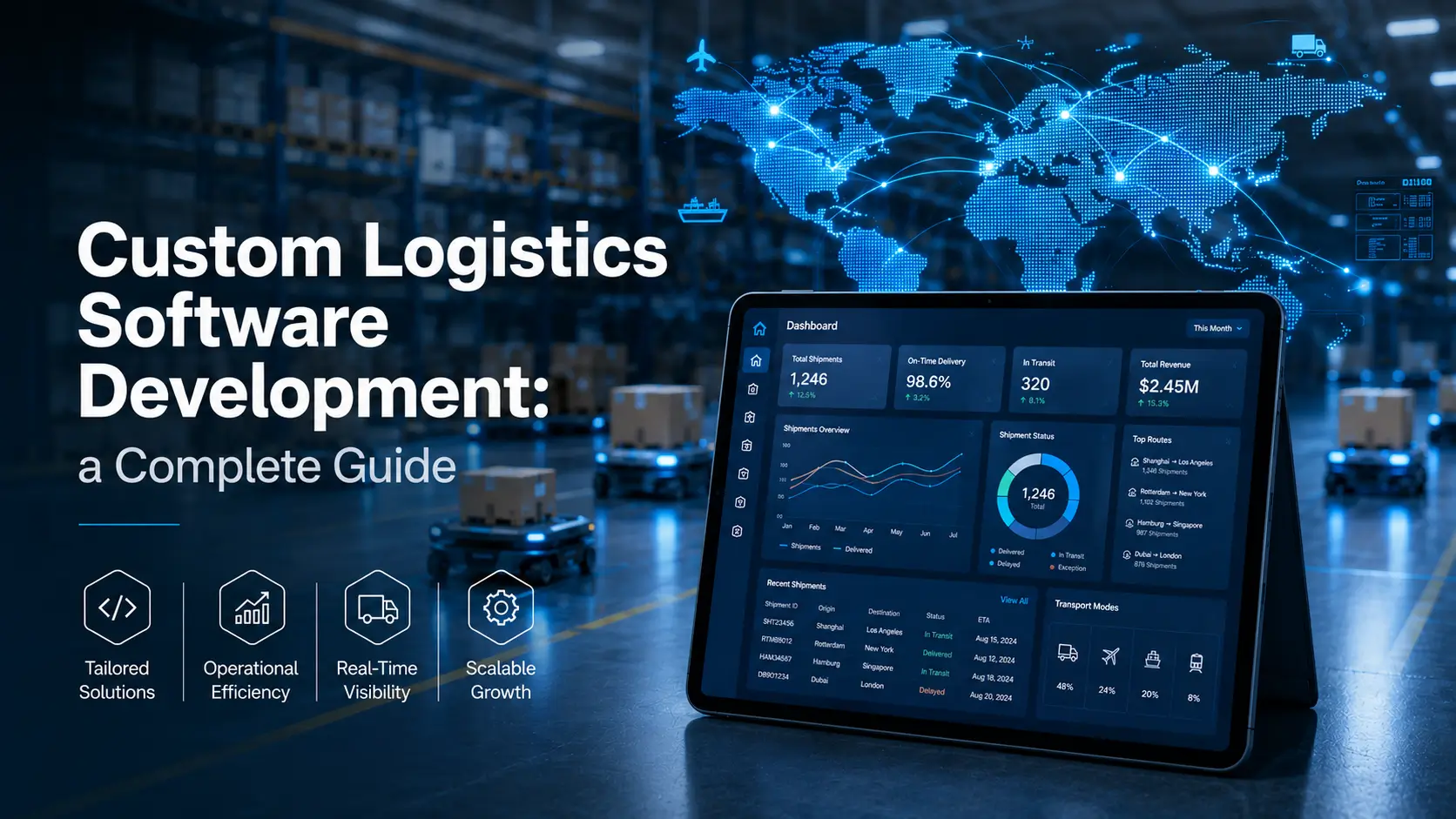
Custom logistics software development is the engineering of tailored digital platforms—such as transportation management systems, warehouse management systems, and freight portals—designed around an organization’s specific operational workflows. By replacing rigid commercial software, bespoke logistics applications eliminate recurring licensing bottlenecks, automate tracking, and directly integrate proprietary carrier networks with existing ERPs. This guide details the core architecture, essential functional modules, integration standards, and phased engineering process required to deploy a scalable logistics solution.
Key Takeaways
- Bespoke logistics platforms grant organizations full code ownership, enabling proprietary route algorithms and eliminating per-user or per-vehicle subscription escalations.
- A functional modern logistics ecosystem unifies transportation management, warehouse oversight, and telematics into a centralized data layer.
- Protocol adherence—specifically Electronic Data Interchange standards and hardware telematics integration—is critical for automated data exchange across shipping partners.
- Offline-first mobile architecture prevents operational blackouts when commercial drivers navigate remote zones with intermittent cellular coverage.
- Iterative, phased development focused on high-friction operational workflows reduces rollout risks and accelerates return on investment.
Why Build Custom Logistics Software Instead of Off-the-Shelf SaaS?
Commercial off-the-shelf logistics platforms offer rapid deployment, but they enforce rigid operational models. Growing freight forwarders, third-party logistics firms (3PLs), and brokers frequently find that generic platforms cannot accommodate unique billing formulas, custom contract terms, or specialized hardware. When businesses adapt their workflows to software constraints rather than tailoring tools to proven procedures, operational drag increases.
Software-as-a-Service (SaaS) providers also structure pricing around seat licenses, active vehicle counts, or transaction volumes. As an enterprise fleet expands, these recurring expenses compound quickly. Furthermore, relying on multi-tenant platforms leaves organizations vulnerable to feature deprecations, forced migrations, and restricted database access.
Building proprietary software establishes technical autonomy. When an organization owns its software infrastructure, it retains complete control over proprietary algorithms, dispatch logic, and client interfaces. Operational data remains accessible without vendor-imposed query limitations. NetClubbed provides custom logistics software development services for growing freight operators and digital agencies supporting enterprise supply chains.
In our experience at NetClubbed, Full Stack Developer Lalit Nagar has found that the biggest friction when migrating mid-market freight brokers off spreadsheets isn’t the UI, it’s the data underneath it. Years of ad-hoc Excel formulas, duplicate carrier records, and inconsistent load numbering schemes have to be cleaned and normalized before they can map cleanly into a relational TMS schema. On past migrations, dispatch workflows that relied on manual phone/email confirmations also needed to be re-modeled as explicit status states in the new system, since a TMS can’t enforce rules on a process that was never formally defined in the first place.
Custom Logistics Software vs. Commercial Off-the-Shelf (COTS) Platforms
| Decision Factor | Custom Logistics Software | Off-the-Shelf SaaS Platforms |
| Workflow Alignment | Built around specific routing, billing, and dispatch rules. | Forces operations into standardized, rigid vendor workflows. |
| Total Cost of Ownership | Initial capital investment with zero recurring user or vehicle fees. | Low starting cost with escalating monthly subscription tiers. |
| Integration Capabilities | Direct connectivity with proprietary ERPs, custom telematics, and EDI. | Restricted to vendor app marketplaces and metered API endpoints. |
| Data Control & Security | Complete ownership of telemetry logs, client data, and algorithms. | Multi-tenant storage governed by third-party policies and export limits. |
| Scalability & Modifications | Codebase evolves on demand as service models expand. | Constrained by vendor roadmaps; custom changes rarely supported. |
| Implementation Timeline | Phased engineering covering discovery, testing, and deployment. | Fast initial setup, but extended configuration for custom processes. |
Core Modules of an Enterprise Logistics System
A comprehensive logistics platform consolidates disconnected business processes into an interconnected operational system. Most modern architectures prioritize four functional modules:
1. Transportation Management System (TMS)
The TMS manages the physical transportation of goods. Core functions include automated carrier selection, freight rating, multi-stop route optimization, and electronic bill of lading (eBOL) processing. Advanced TMS modules analyze historic route durations, toll charges, and vehicle capacity constraints to allocate cargo efficiently. Centralized load tendering eliminates manual phone check-ins and scattered email threads.
2. Warehouse Management System (WMS)
A custom WMS manages inventory receipt, put-away, cross-docking, storage location tracking, and order fulfillment. Tailored WMS modules use barcode and RFID scanning to verify inventory accuracy at the bin level. Direct integration with picker mobile devices optimizes warehouse travel paths, lowering cycle times during picking and packing.
3. Fleet Telematics and Driver Management
Fleet management components bridge the gap between dispatchers and drivers on the road. These modules track vehicle diagnostic data, preventative maintenance intervals, fuel expenditures, and driver hours. Under guidelines from the Federal Motor Carrier Safety Administration, electronic logging devices must automatically capture engine hours, motion status, and driving time to ensure regulatory compliance. Custom telematics systems feed this operational data directly into compliance dashboards.
4. Visibility Portals and Customer Tracking
Client-facing tracking dashboards eliminate routine status inquiries by offering end-to-end shipment visibility. Shippers, consignees, and freight brokers receive dynamic estimated times of arrival (ETAs) based on active telematics data and transit milestones. Implementing role-based permission tiers ensures customers see shipment statuses, proofs of delivery, and freight invoices without accessing internal cost data.
Software Architecture and Integration Ecosystem
Logistics software operates within an ecosystem involving physical vehicles, distributed warehouses, external carriers, and trading partners. Building a dependable platform requires modular architecture and standard data exchange protocols.
According to Gartner’s analysis of supply chain technology trends, modern logistics operations are increasingly driven by intelligent automation and unified data connectivity across transportation networks. Achieving this connectivity demands careful architectural planning:
- Modular Monolith vs. Microservices: For most mid-market logistics platforms, a modular monolith using clean domain boundaries provides fast development cycles and simplified debugging. High-throughput enterprises handling heavy daily sensor traffic benefit from microservices deployed on containerized infrastructure to scale route calculation and telemetry pipelines independently.
- Electronic Data Interchange (EDI): Freight commerce relies heavily on ANSI X12 and EDIFACT protocols. Custom logistics backends must process core transaction sets, including EDI 204 (Load Tender), EDI 214 (Shipment Status Message), EDI 210 (Freight Invoice), and EDI 850 (Purchase Order). Direct parsing and generation of these documents eliminates intermediary translation fees.
- REST and GraphQL APIs: Modern logistics software uses secure REST or GraphQL endpoints to connect internal modules with external services, including accounting suites, CRM applications, and public traffic engines.
- Telematics and IoT Protocols: Vehicle telemetry requires processing continuous streams of GPS coordinates, temperature metrics for cold chain compliance, and engine diagnostics. Utilizing lightweight messaging protocols such as MQTT ensures low bandwidth consumption and reliable transmission over cellular networks.
For mobile driver apps operating in low-connectivity rural zones, Lalit Nagar’s approach at NetClubbed has been to treat the device as the source of truth during a dispatch, not the server. The app writes every status update, POD, and location ping to a local database first, then syncs to the backend in the background whenever a connection becomes available, using a queue that retries with backoff instead of blocking the driver’s workflow. Caching the day’s assigned routes and customer details locally each morning, rather than fetching them on demand, has also made the app usable even when a driver loses signal for hours at a stretch.
Step-by-Step Custom Logistics Software Development Process
Building custom logistics software requires a methodical engineering approach that avoids disruptions to live distribution networks. Following an organized implementation framework ensures projects stay aligned with business objectives:
- Operational Discovery and Workflow Mapping: Document every dispatch handoff, warehouse touchpoint, billing calculation, and exception-handling routine. Interview drivers, dispatchers, and warehouse personnel to identify specific operational bottlenecks and edge cases.
- Architecture and Data Modeling: Design the database schema, entity relationships, and communication protocols. Establish data contracts for external carrier APIs and determine whether the application will rely on relational databases for financial consistency or document stores for unstructured telemetry feeds.
- Core MVP Engineering: Prioritize the single workflow causing the greatest operational friction, such as dispatch scheduling or order tracking. Build, test, and release this minimum viable product first to establish a functioning baseline and collect direct end-user feedback.
- Third-Party and Hardware Integration: Connect the platform to existing hardware, including in-cab ELD units, handheld barcode scanners, and warehouse thermal printers. Integrate legacy ERP software and configure automated EDI processing pipelines.
- Rigorous Pilot Validation: Deploy the platform in a controlled testing environment or with a limited sub-fleet. Test corner cases, including offline driver sync, network timeouts, duplicate order submissions, and unexpected route deviations.
- Staged Rollout and Maintenance: Roll out the system facility by facility or region by region rather than attempting a high-risk switchover. Establish comprehensive logging, performance monitoring, and an iterative update schedule to refine routing algorithms as dispatch volume grows.
When testing EDI 214 shipment status pipelines for peak holiday volumes, our QA process at NetClubbed, built around Lalit Nagar’s full stack testing experience, focuses on simulating realistic burst traffic rather than just steady load. We replay batches of out-of-sequence and duplicate 214 segments, since carriers don’t always send updates in order during high-volume periods, and verify the system still reconciles shipment status correctly. Load tests are run against several times the expected peak message rate to confirm the queue and database layer stay stable instead of silently dropping or delaying updates when volume spikes around the holidays.
Technical Challenges and Risk Mitigation
Managing Disconnected Mobile Workflows
Commercial delivery drivers regularly traverse areas with weak or nonexistent cellular service. If a mobile driver application relies entirely on constant cloud connectivity, drivers cannot record signatures, capture delivery photos, or confirm drop-offs. Custom mobile engineering solves this issue using offline-first architecture. By storing transaction queues in local device storage such as SQLite and applying conflict-resolution rules upon reconnection, mobile applications maintain continuous operations without data loss.
Legacy Data Migration and System Coexistence
Most supply chain operators maintain years of customer history, freight audit trails, and inventory records inside legacy databases. Transitioning to a new platform requires automated migration scripts with validation checks to catch corrupted or malformed entries. Running the custom application parallel with legacy systems during initial rollout stages provides a reliable safety net until the new platform verifies complete data integrity.
Data Security and Access Control
Supply chain databases contain high-value proprietary information, including customer pricing tables, vendor contracts, freight manifests, and driver records. Custom systems must implement granular role-based access control, multi-factor authentication, and encryption for data both in transit and at rest. Segregating customer-facing portals from back-office operational consoles prevents inadvertent exposure of commercial margins.
Frequently Asked Questions
A targeted minimum viable product focused on a single workflow typically requires three to five months to engineer and deploy. Full-scale enterprise platforms combining advanced TMS, WMS, and fleet telematics generally take six to nine months of iterative development depending on integration complexity.
Custom logistics software integrates automated EDI parsers and translators that convert standard formats like EDI 204 or EDI 214 into internal database structures. This allows direct data exchange with freight brokers and retailers without relying on costly third-party translation software.
Yes. Custom logistics software is built with dedicated API connectors that link directly to enterprise ERPs such as SAP, Oracle, or Microsoft Dynamics. This bi-directional communication ensures inventory movements, shipment charges, and order statuses update across all financial and management systems automatically.
Custom software eliminates per-vehicle and per-user monthly subscription fees while allowing fleets to own proprietary route optimization logic. It also enables direct integrations with unique vehicle hardware and custom billing models that commercial off-the-shelf software cannot accommodate.
Conclusion
Custom logistics software replaces the operational compromises of generic platforms with systems engineered around your exact distribution workflows. By unifying transportation management, warehouse inventory, and automated partner integrations under one architecture, organizations eliminate third-party licensing fees, gain full control of proprietary data, and build long-term operational resilience.
To evaluate your supply chain workflows and plan a scalable technology roadmap, book a free consultation at netclubbed.com.