 Akshay Tyagi
In today’s logistics environment, operational efficiency is the only way to survive. As fuel prices fluctuate and supply chain demands intensify, relying on manual logs or rigid legacy systems is a liability. Modern fleet management software (FMS) has transitioned from simple GPS tracking into an AI-driven command center that empowers data-backed decision-making.
Building a custom solution is no longer a luxury reserved for logistics giants; it is a strategic move to eliminate “software fatigue” and gain full control over your data. By partnering with an experienced logistics software development company, businesses can create tailored tools that address specific operational bottlenecks. This guide breaks down the essentials of fleet management software development, the modern tech stack, and a roadmap to building a resilient platform.
Why Choose Custom Fleet Management Software Development?
The global fleet management market is accelerating, with projections to reach $52.4 billion by 2030. While off-the-shelf SaaS products are available, they often lack the flexibility to handle unique niche workflows or integrate with proprietary ERP systems.
Key Benefits of Custom Solutions:
- Drastic Cost Reductions: Advanced FMS users report an average 15% reduction in fuel costs through better routing and idle-time monitoring.
- Automated Regulatory Compliance: Build ELD (Electronic Logging Device) and GDPR compliance directly into your architecture to avoid legal friction.
- Lower Insurance Premiums: Proving a commitment to safety through driver behavior tracking can significantly lower your liability costs.
Essential Features: What Every Modern FMS Needs
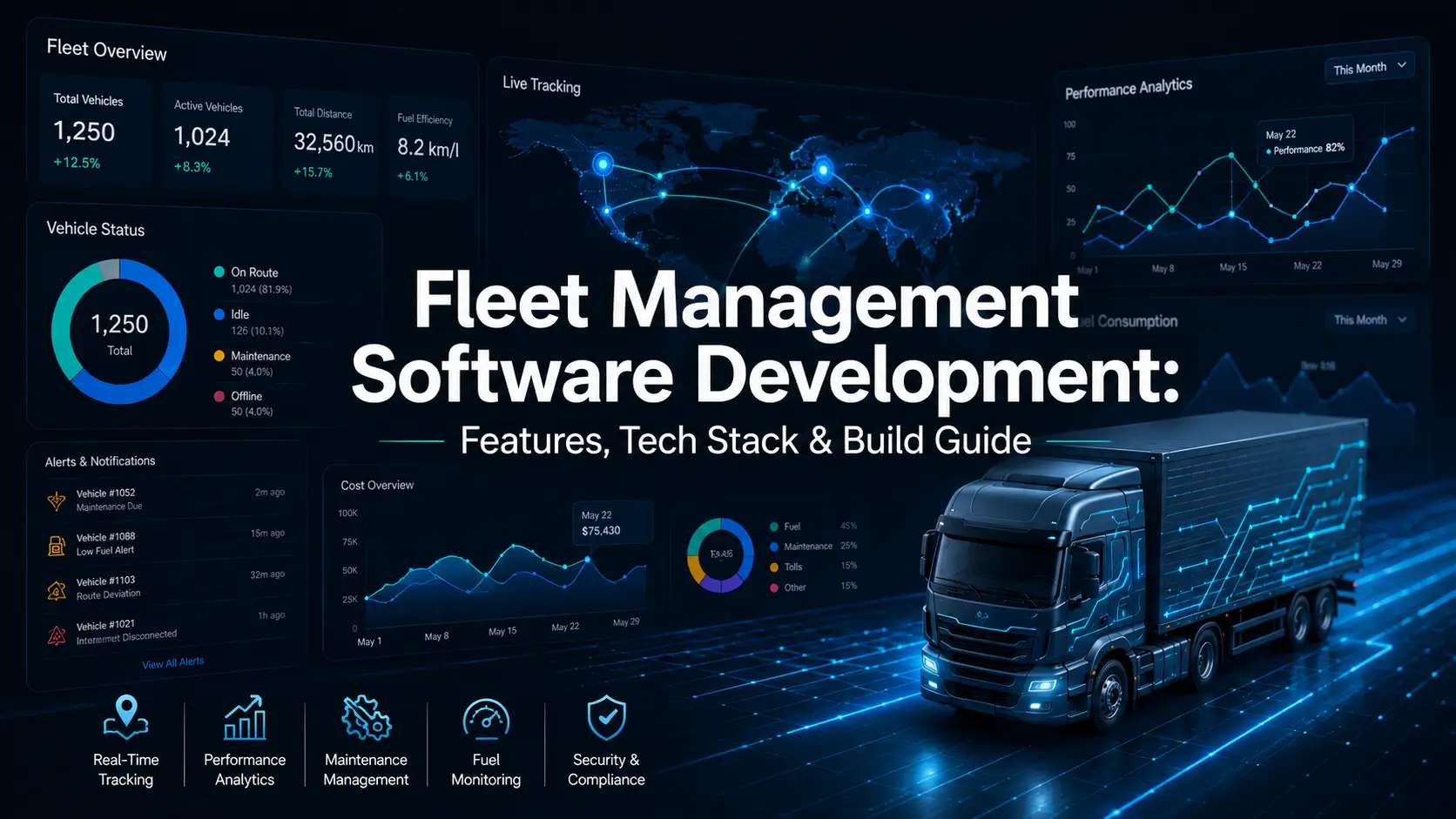
To provide real value, your software must seamlessly bridge the gap between vehicle hardware and the back-office dashboard. Every high-performance FMS should include these four pillars:
1. High-Precision Real-Time Tracking
Utilizing GPS and GLONASS, your system must provide sub-meter accuracy. The focus here is low-latency data transmission—dispatchers should see vehicle movements in near real-time (1–5 second intervals) to handle dynamic rerouting.
2. Telematics and Remote Diagnostics
By tapping into the vehicle’s OBD-II or CAN-bus ports, the software monitors engine health, fuel consumption, and mileage. Detecting a “Check Engine” code remotely allows for “Just-in-Time” maintenance, preventing expensive roadside failures.
3. AI-Driven Route Optimization
Modern pathfinding goes beyond the shortest distance. It uses machine learning to analyze traffic patterns, weather, and delivery windows to minimize “deadhead” miles—ensuring your fleet stays profitable on every leg of the journey.
4. Driver Behavior & Safety Analytics
Safety is a critical KPI. Use your software to track “harsh events” like sudden braking or rapid acceleration. Generating Driver Scorecards encourages a culture of safety and provides tangible data for performance reviews.
Modern Trends: Advanced Features for a Competitive Edge
To future-proof your investment, consider these emerging technologies:
- Predictive Maintenance: Moving from “reactive” to “proactive” by using ML models to predict parts failure before it occurs.
- EV Fleet Integration: Specialized modules to track State of Charge (SoC), battery health, and charging station proximity—essential as fleets transition to electric.
- Video Telematics: AI-powered dashcams that detect driver distraction or fatigue using computer vision, providing instant audio alerts.
Choosing the Right Tech Stack for Scalability
Your fleet management tech stack must be built to handle “high-velocity data.” Thousands of vehicles pinging a server every second requires a robust architecture.
- Backend Frameworks: Python (FastAPI or Django) is ideal for AI/ML integration. Node.js is preferred for real-time, event-driven communication.
- The Database Layer:
- PostgreSQL for relational data (user profiles, billing).
- TimescaleDB or InfluxDB for Time-Series Data. This is vital for storing chronological GPS coordinates and sensor logs efficiently.
- Connectivity Protocols: MQTT is the industry standard for IoT. It is lightweight and ensures data delivery even in areas with poor cellular reception.
- Cloud & Infrastructure: Utilizing AWS IoT Core allows you to manage “device twins,” making it easier to sync hardware data with your software dashboard.
The 6-Step Guide to Developing Your FMS
- Discovery & Requirement Mapping: Define your user personas. The needs of a long-haul trucker differ wildly from a last-mile delivery manager.
- UI/UX Design: Focus on “at-a-glance” intelligence. Use heatmaps and intuitive charts to prevent dashboard fatigue.
- Hardware Selection: Decide between hardwired “black boxes,” plug-and-play OBD-II dongles, or smartphone-based tracking.
- Backend & API Development: Build the microservices that process and clean incoming telematics data.
- Rigorous Quality Assurance: Stress-test the system by simulating high-traffic loads to ensure zero data loss during peak operations.
- Compliance & Deployment: Ensure the system meets DOT (Department of Transportation) requirements and hours-of-service (HOS) logging standards.
What is the Cost of Fleet Management Software Development?
The investment required depends on the complexity of the features:
- Basic MVP: Focuses on GPS tracking and simple reporting ($40,000 – $70,000).
- Enterprise Solution: Includes AI diagnostics, video telematics, and full ERP integration ($150,000+).
Pro Tip: Start with a robust MVP and scale features based on real-world driver feedback and operational bottlenecks.
Conclusion: The Future of Fleet Intelligence
The logistics industry is rapidly moving toward a future that is autonomous, electric, and hyper-connected. Investing in custom fleet management software development today ensures you own your data and your process. By shifting from reactive management to proactive intelligence, you position your business to thrive in an increasingly competitive global market.
You Might Also Like