 Lalit Nagar
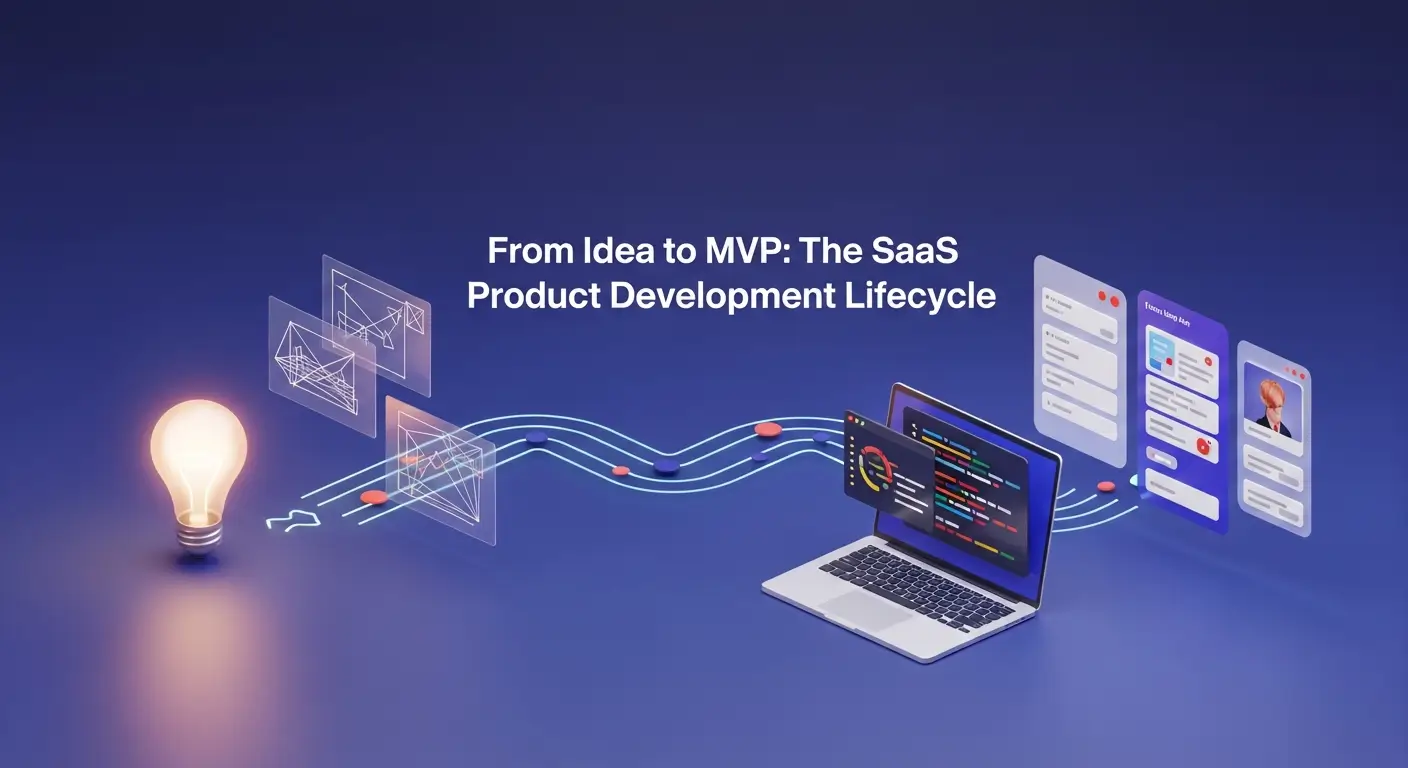
The SaaS product development lifecycle is an iterative engineering process that takes a cloud software concept through problem validation, multi-tenant architecture design, Minimum Viable Product (MVP) development, automated security testing, and post-launch iteration. Unlike single-deployment software, a SaaS MVP requires foundational cloud capabilities—including tenant data isolation, subscription billing, and identity management—alongside its core user workflow. Following a structured lifecycle prevents scope creep and validates commercial demand early.
Key Takeaways
- Validate before architecting: Confirm user pain points and willingness to pay through buyer interviews and clickable prototypes before writing production code.
- Scope around one core workflow: A SaaS MVP should solve one primary business problem end-to-end rather than offering partial versions of secondary features.
- Design for multi-tenancy early: Establish tenant context and data isolation at the database and application layers from day one to avoid costly rewrites.
- Offload billing and authentication: Use established payment and identity infrastructure rather than building custom recurring billing engines from scratch.
- Automate security checks: Integrate vulnerability scanning and cross-tenant access tests directly into your continuous build pipeline.
How the SaaS Product Development Lifecycle Differs from Traditional Software
While a SaaS build shares core engineering disciplines with standard custom software development lifecycle stages, delivering software as a subscription service introduces distinct architectural demands. Traditional bespoke software is deployed for a single organization with fixed boundaries, whereas a SaaS platform serves multiple independent customer organizations—known as tenants—from a unified codebase and operational control plane.
Early architectural decisions directly affect unit economics, data privacy, and release velocity. Product teams must distinguish between a prototype, a SaaS MVP, and a full production release so engineering effort matches the current validation goal.
| Lifecycle Milestone | Primary Objective | Technical Architecture | Tenant & Billing Capability | Validation Signal |
| Clickable Prototype | Test workflow clarity with target buyers | Interactive UI mockups with no backend code | Simulated screens only | Buyers confirm the workflow solves their problem |
| SaaS MVP | Deliver core value and validate recurring revenue | Modular codebase with multi-tenant data isolation | Self-serve onboarding and standard subscription checkout | Early tenants onboard, complete the core action, and pay |
| Full Production Platform | Scale acquisition, retention, and enterprise compliance | High-availability cloud infrastructure with auto-scaling | Tiered plans, role-based access control, and audit logs | Sustained retention and expansion across customer segments |
The 6 Core Stages of the SaaS Product Development Lifecycle
Moving from an initial concept to a live MVP requires disciplined execution across six connected phases.
Stage 1: Problem Discovery and Commercial Validation
The lifecycle begins by proving that a specific target audience experiences a recurring operational problem and will pay for a software solution. Solo founders and product leads can also use an AI co-founder during early ideation to stress-test business hypotheses and refine initial feature scope before committing engineering budget. Follow this four-step discovery sequence:
- Document the problem hypothesis: Define the target persona, the triggering business event, and why existing spreadsheets or manual workarounds fail.
- Conduct structured buyer interviews: Interview decision-makers and daily operators about workflow bottlenecks without pitching your product idea upfront.
- Map the minimum viable workflow: Identify the shortest path from user login to the primary value outcome, cutting non-essential administrative screens.
- Test commercial commitment: Secure letters of intent, pilot commitments, or waitlist signups tied to a transparent pricing structure.
The exercise that consistently cuts the most scope is asking a founder to describe the core workflow as a single sentence with no “and” in it — the moment they need “and” to describe what the MVP does, there are two products hiding in one scope. Pairing that with a simple fake-door test, where a feature is presented as a button or waitlist signup before it’s built, tells you fast whether buyers actually want a capability or whether it just sounded good in a planning meeting. Both are cheap to run and routinely cut 30-40% of a proposed feature list before a single line of code gets written.
Stage 2: Multi-Tenant Architecture and Tech Stack Selection
Once scope is locked, architects define how the platform stores data and isolates customers. According to the AWS Well-Architected SaaS Lens design principles, every SaaS architecture must isolate tenant resources from cross-tenant access across all layers while enabling tenants to be onboarded and managed through a single operational view.
Teams choose a data isolation model based on compliance and target market needs:
- Pooled model: Tenant records share database tables, separated by a tenant identifier and row-level security policies to minimize infrastructure overhead.
- Bridge model: Tenants share database instances, but each customer receives a dedicated schema for stronger logical separation.
- Silo model: Each tenant runs on dedicated database or compute resources, common for regulated enterprise or healthcare clients.
Most early-stage teams build a modular monolith—using frameworks like Laravel, Node.js, or React—to ship quickly without microservices orchestration overhead. When the product requires persistent real-time connections, comparing Elixir and Node.js for high-traffic applications helps technical leads select a backend runtime that fits their concurrency profile.
Stage 3: UX/UI Design and Interactive Prototyping
In SaaS, user experience governs trial-to-paid conversion. Designers translate the validated workflow into wireframes and clickable prototypes focused on frictionless onboarding—guiding new tenants from signup to their first activation milestone with minimal configuration. Reusable UI component libraries are established during this stage, and usability tests are conducted with target buyers while design revisions remain inexpensive.
Stage 4: Core MVP Engineering, Auth, and Subscription Billing
With validated designs and a multi-tenant schema, developers build the core workflow alongside commercial SaaS infrastructure. NetClubbed provides custom SaaS application development for startups, mid-market businesses, and agencies moving from architectural blueprints to a production-ready MVP.
A functional SaaS MVP integrates three foundational layers:
- Core application plane: The specific workflow, automation engine, or specialized AI agent that customers pay to use.
- Identity and tenant context: Authentication, organization workspaces, and role-based permissions binding every API request to a verified tenant identifier.
- Subscription and entitlement logic: Integration with a managed billing engine. As detailed in the Stripe Billing documentation, managed subscription APIs automate recurring invoicing, trial periods, payment collection, and webhook-driven plan changes.
Offloading auth to a managed identity provider instead of building it saves the most time in the first sprint, hands down — session handling, password resets, and social login all come free instead of being a week of edge-case bug fixing. Right behind that is using a managed billing provider’s hosted checkout rather than building a custom subscription flow; webhook-driven entitlement logic (turning features on/off based on subscription state) is deceptively fiddly to get right, and starting with a provider’s prebuilt webhook handlers instead of writing them from scratch avoids a class of bugs we’ve seen eat entire sprints on early builds.
Stage 5: Quality Assurance, Tenant Isolation, and Security Testing
SaaS quality assurance verifies functional workflows, tenant isolation boundaries, and performance under concurrent load so one customer’s usage spike cannot degrade availability for others. Following the NIST Secure Software Development Framework (SP 800-218), teams should embed security throughout the lifecycle by protecting build environments, scanning code and dependencies for vulnerabilities, and testing access controls before release.
Stage 6: Deployment, Telemetry, and Validated Iteration
SaaS teams deploy via Continuous Integration and Continuous Deployment (CI/CD) pipelines with zero-downtime database migrations. Once initial tenants onboard, product telemetry tracks activation completion, feature adoption frequency, and per-tenant error logs to guide whether upcoming sprints focus on resolving onboarding friction or adding workflow capabilities.
The signal we trust most isn’t signup volume — it’s whether early tenants are returning and completing the core workflow a second and third time without being prompted. A product can get plenty of signups from a good landing page, but if activation doesn’t repeat on its own, scaling paid acquisition just buys you a bigger churn number. Once a meaningful share of early tenants are coming back and hitting the core action repeatedly without hand-holding, that’s a much stronger “ready to scale” signal than raw top-of-funnel traffic.
Pre-Launch SaaS MVP Readiness Checklist and Common Red Flags
Before inviting external customers into production, verify these five launch criteria:
- Tenant data isolation verified: Automated tests confirm all queries enforce tenant context and prevent cross-organization data leakage.
- Billing lifecycle tested end-to-end: Subscription creation, trial expiration, payment retries, and cancellation webhooks update account entitlements accurately.
- Self-serve onboarding complete: New tenants can register, configure their workspace, and complete the core action without manual database edits.
- Backups and rollback pipeline active: CI/CD deployments support quick rollbacks, and automated database snapshots are tested for restoration.
- Tenant-aware observability configured: Application logs include tenant identifiers so engineers can diagnose errors and monitor latency per customer.
Avoid these common red flags that derail early-stage SaaS builds:
- Building custom billing or auth from scratch: Writing proprietary invoice engines or authentication protocols drains budget from your core product workflow.
- Premature microservices: Splitting an unvalidated MVP into distributed services introduces deployment and debugging complexity before traffic justifies it.
- Retrofitting multi-tenancy late: Building a single-user app first and adding organization workspaces later forces costly rewrites across every database query.
Frequently Asked Questions (FAQ)
A Proof of Concept (PoC) is an internal technical experiment verifying that a specific integration or algorithm is feasible. A prototype is an interactive visual mockup used to test usability with buyers, whereas a SaaS MVP is a live cloud application with multi-tenant authentication, data persistence, and core business logic.
A modular monolith is preferable for a SaaS MVP because it keeps all code in a single deployable repository while maintaining clean boundaries between domain modules. This allows small engineering teams to iterate on schemas and features quickly while preserving the option to extract high-load services later.
For self-serve SMB or B2C products, integrating hosted checkout and subscription webhooks before launch is essential to validate willingness to pay and automate entitlements. For high-touch B2B enterprise pilots, teams can initially collect payments via hosted invoicing links while enforcing tenant-level feature flags in code.
Conclusion
Navigating the SaaS product development lifecycle from idea to a revenue-ready MVP requires balancing commercial validation with disciplined multi-tenant engineering. By locking scope around one core workflow, enforcing tenant isolation early, and leveraging proven billing and security frameworks, founders can launch faster without accumulating heavy technical debt.
Ready to turn your SaaS concept into a scalable cloud product? Book a free consultation at netclubbed.com and contact us for a quote.