 Sumit Yadav
Hiring a web development company is best for complex builds needing multidisciplinary skills, structured quality assurance, and project continuity. A freelance developer suits smaller builds, isolated bug fixes, or tight budgets where internal managers can oversee execution directly. The right decision hinges on your project scope, delivery timeline, internal management capacity, and technical risk tolerance.
Key Takeaways
- Scope defines fit: Freelancers excel at discrete tasks and single-stack brochure sites, while development agencies handle multi-tier architectures and complex integrations.
- Risk management: Working with a company eliminates single-point-of-failure risks like contractor illness or unresponsiveness through distributed team coverage.
- Project governance: Freelancers require you to act as project manager and tester, whereas agencies supply dedicated management, code reviews, and structured milestones.
- Total lifecycle cost: Freelancers have lower hourly rates, but unmanaged scope creep or post-launch technical debt can erode upfront savings.
- Support longevity: Established development firms provide formal service level agreements (SLAs) and infrastructure maintenance that solo contractors rarely sustain.
Structural Differences: Solo Contributor vs. Multidisciplinary Agency
A modern website or web application is rarely the work of a single person. Modern web production requires user interface design, front-end development, server architecture, database configuration, DevOps deployment, and security hardening.
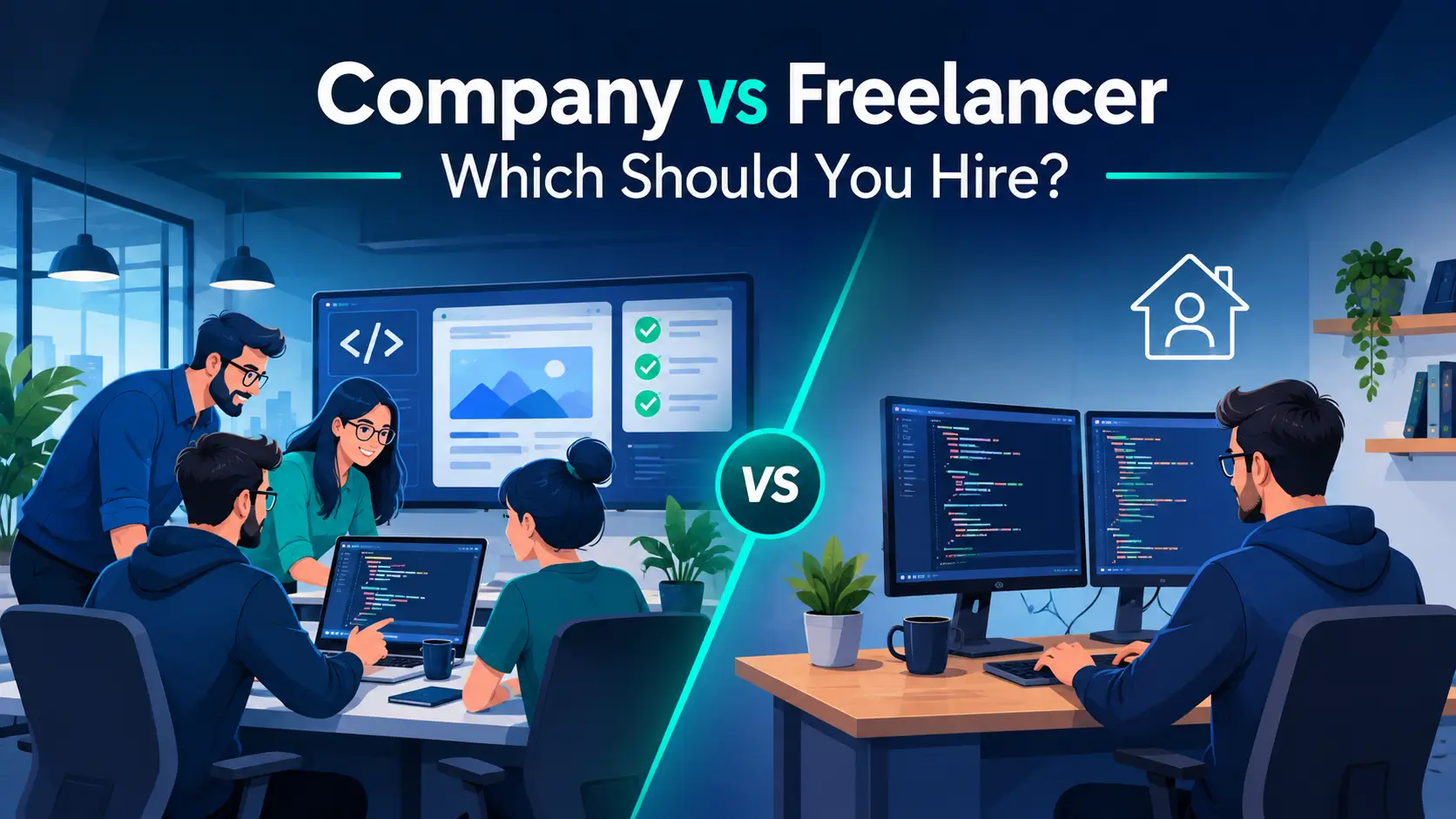
Engaging a freelance web developer gives you direct access to an independent specialist. Freelancers offer direct communication, low overhead, and quick turnaround for small, self-contained assignments. However, solo contractors must balance coding with administrative duties, client meetings, and debugging. If your build encounters complex roadblocks—such as custom API synchronizations or database bottlenecks—a solo developer must research solutions on your time. Personal emergencies, illness, or competing client deadlines can also stall releases without warning.
Conversely, a web development company functions as an orchestrated team. A typical project squad includes a project manager, UI/UX designer, front-end engineer, back-end engineer, and a dedicated QA tester. Agencies establish standardized version control workflows, automated build pipelines, and mandatory peer code reviews. If an individual engineer takes leave, team redundancy ensures another developer steps in without losing project context.
The bottleneck we hear about most often from digital agencies isn’t skill gaps — it’s availability collapsing right when a deliverable matters most. A freelancer gets pulled onto a competing client’s emergency, goes quiet for a few days during a crunch, and the agency has no visibility into whether the work is actually progressing until the deadline is already missed. That unpredictability, more than any technical shortfall, is what pushes agencies toward a white-label partner structure where there’s always someone accountable to check in with.
Evaluating Cost, Risk, and Long-Term Value
Comparing agencies and solo developers solely on upfront quotes often leads to flawed hiring decisions. Hourly rates reflect overhead, but they ignore the total cost of ownership across the digital asset lifecycle.
Freelance developers offer lower initial rates because they carry minimal business overhead. This model works well for early-stage landing pages, simple content sites, or short-term marketing initiatives. However, relying on a single individual creates structural vulnerability for revenue-critical platforms. When a solo contractor departs, onboarding an unfamiliar developer to decipher undocumented code creates severe friction and costly refactoring.
According to long-term project research from the Standish Group CHAOS Report, approximately 31% of software initiatives successfully deliver on time, within budget, and with their full original feature scope, while over 50% face challenges due to changing scope, missing requirements, or coordination bottlenecks. These failures often stem from inadequate discovery, missing quality control, and fragmented architecture.
Data from the Stack Overflow Developer Survey highlights that technical engineering roles are increasingly segmented across specialized back-end, front-end, cloud, and quality disciplines, making it difficult for an individual contributor to execute every layer of a modern application with equal rigor. NetClubbed provides dedicated custom web development services and staff augmentation teams for digital agencies and growing businesses.
When we audit a freelancer-built codebase ahead of a migration or handoff, the most common issue isn’t broken functionality — it’s the complete absence of input validation and sanitization around forms and database queries, left exposed because nobody flagged it as a priority under deadline pressure. Right behind that, we routinely find hardcoded API keys and credentials committed directly into the codebase instead of environment variables, which is a basic hygiene step that gets skipped when there’s no second engineer reviewing the work before it ships.
Comprehensive Comparison: Development Company vs. Freelancer
Selecting the right hiring route requires aligning project requirements with operational reality. The table below compares both models across fundamental delivery parameters.
| Evaluation Factor | Freelance Web Developer | Web Development Company |
| Best Project Fit | Simple websites, landing pages, bug fixes, and minor theme updates | Custom web applications, enterprise portals, e-commerce, and redesigns |
| Skill Diversity | Focused on individual core strengths; generalist across other areas | Cross-functional team with UX/UI, front-end, back-end, DevOps, and QA |
| Project Management | Managed by the client or self-directed by the developer | Dedicated project manager following structured agile sprints and milestones |
| Quality Assurance | Self-tested by the developer; testing depth varies with schedule pressure | Independent QA engineers performing functional, security, and device testing |
| Delivery Redundancy | High risk; single point of failure if the developer faces unavailability | High continuity; team members step in if individual developers rotate |
| Accountability & Legal | Individual contracts; limited legal recourse and varying IP enforcement | Formal corporate contracts, structured SLAs, clear NDAs, and full IP assignment |
| Scalability of Scope | Constrained by individual weekly hours and existing client workload | Elastic capacity; ability to add engineering, design, or QA resources on demand |
| Post-Launch Maintenance | Subject to future freelancer availability and competing client queues | Formal maintenance retainers, automated monitoring, and scheduled security patches |
Step-by-Step Decision Framework: Which Should You Hire?
Evaluate your project against this five-step framework to determine the optimal hiring model.
- Assess technical complexity and architectural requirements: If your project involves standard CMS setup or visual styling tweaks, an experienced freelance developer is a practical choice. If the build requires custom back-end logic, payment integrations, microservices, or complex database relationships, hire a development company.
- Audit internal management and QA bandwidth: Hiring a freelancer requires you to write technical specifications, inspect pull requests, and manage quality testing. If you lack in-house technical leadership, an agency provides the management and QA testing necessary to safeguard delivery.
- Gauge business downtime and risk tolerance: If an extended delay or post-launch bug will directly harm revenue, damage client relationships, or expose customer data, an agency offers superior protection through contractual guarantees and liability safeguards.
- Determine delivery timeline and speed requirements: An individual developer has a strict capacity limit. If your launch date requires concurrent workstreams—such as interface prototyping, API construction, and cloud provisioning—an agency can deploy multiple specialists in parallel.
- Plan for post-launch maintenance and continuous upgrades: Software requires ongoing security patching, dependency upgrades, and performance tuning. If you need reliable long-term support without contractor turnover risks, an agency SLA provides operational stability.
With a solo freelancer retainer, ticket turnaround is really a function of that one person’s current workload, so a client might wait anywhere from a day to over a week for something minor, with no real recourse if other clients take priority. A structured agency SLA removes that guesswork by committing to fixed response windows — for us, critical issues get acknowledged within hours, not days — simply because the work is distributed across a team rather than queued behind one person’s availability.
Frequently Asked Questions
An experienced full-stack freelancer can construct functional web applications, but delivery speed and technical depth are constrained. Balancing UI design, complex database architecture, serverless infrastructure, and security auditing stretches solo capacity. Important elements like comprehensive unit testing, cross-browser validation, and complete documentation are often sidelined under tight deadlines.
If your freelancer stops responding, immediately audit and secure your code repositories, hosting accounts, and third-party API credentials to prevent unauthorized changes. Export the latest database backups and commit histories. Once your digital assets are secured, consult a professional web development company to review the codebase and establish a structured plan to complete the build.
Development companies charge higher upfront fees because they deploy a cross-functional team rather than a single generalist. You pay for dedicated project management, peer code reviews, independent quality assurance, and contractual accountability. This structure reduces the financial risk of missed deadlines, security vulnerabilities, and architectural re-platforming.
Agency agreements include formal Master Services Agreements, explicit Work-for-Hire language, non-disclosure terms, and corporate indemnification that transfer full intellectual property ownership to you upon payment. Freelance engagements often rely on basic proposals or generic third-party platform terms that may offer weak legal protection across international jurisdictions.
Conclusion
Choosing between a web development company and a freelancer is an operational decision about risk, scope, and management capacity. Freelance developers offer agile, cost-effective execution for well-defined, low-risk web tasks. When a project represents a core business asset, demands multidisciplinary technical expertise, or requires guaranteed post-launch continuity, a web development company provides the structure and reliability needed to protect your investment.
To assess your project scope and choose the optimal development approach, book a free consultation with NetClubbed to review your technical requirements.