 Sumit Yadav
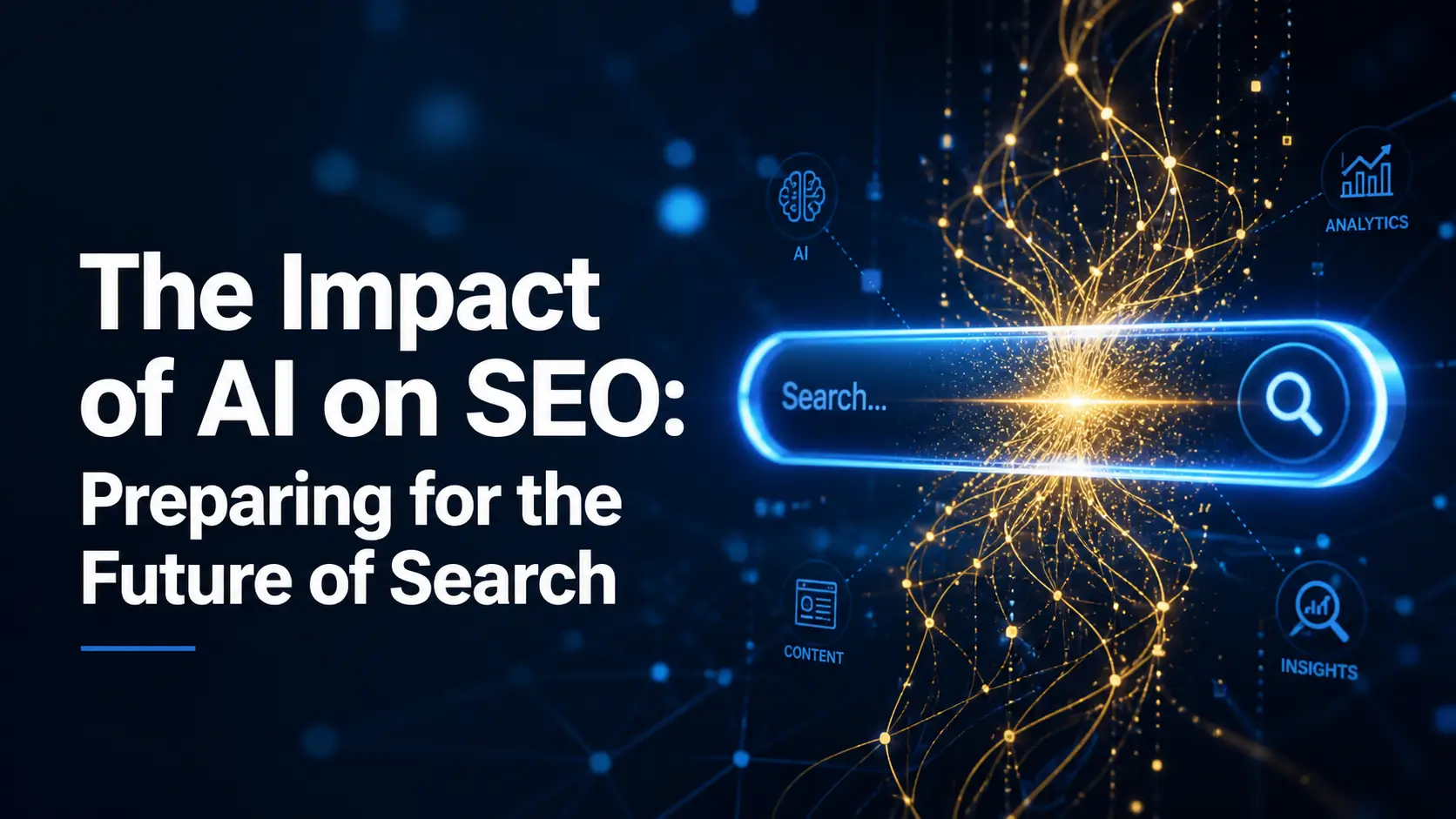
The search bar is no longer just a window to the web; it is evolving into a digital oracle. For over two decades, the “Ten Blue Links” served as the primary bridge between a user’s query and a publisher’s information. However, we have entered a seismic era where Artificial Intelligence doesn’t just help you find a website—it generates the answer for you.
With the rollout of Google’s AI Overviews (formerly SGE), the rise of Perplexity, and ChatGPT’s evolution into a real-time search engine, the digital landscape has shifted. For marketers and business owners, the core objective has changed: The question is no longer just “How do I rank #1?” but “How do I stay visible in an age of zero-click searches?”
The impact of AI on SEO is profound. It requires a fundamental pivot from keyword-matching to authority-building. This guide provides a strategic roadmap to navigate this new frontier—from mastering Generative Engine Optimization (GEO) to leveraging the one thing AI cannot replicate: human experience.
1. The Rise of AI Overviews: Adapting to “Zero-Click” Search
The most significant change in modern search is the integration of LLMs directly into the Search Engine Results Page (SERP).
What are AI Overviews?
AI Overviews synthesize information from across the web into a concise summary at the top of the page. According to data from BrightEdge, over 80% of search queries in high-intent industries now trigger an AI response.
The Challenge: If a user receives a full answer on the search page, your click-through rate (CTR) may drop.
The Opportunity: To survive, you must transition from a “traffic seeker” to a “verified source.” Google’s AI doesn’t invent data; it aggregates it. By structuring your content as a clear, data-backed answer, you increase your chances of being featured in the “source carousel” alongside the AI summary.
2. Beyond Keywords: The Semantic Search Revolution
In the early days of SEO, success was about matching strings of text. If someone searched for “best running shoes,” you repeated that phrase until you ranked. AI has rendered this “exact match” strategy obsolete through Natural Language Processing (NLP).
Mastering “Entity-Based” SEO
Modern search engines now understand entities—the complex relationships between people, places, and concepts.
- Topic Authority over Keywords: Instead of targeting a single keyword, build “Intent Clusters.”
- The Strategy: Create a comprehensive content hub that covers a subject from every angle. This proves to the AI that your site is a definitive resource, making you more “indexable” in a semantic search environment.
3. The New E-E-A-T: Why “Experience” is Your Best SEO Defense
Many marketers are now turning to automated blog writing tools to scale content production, but Google’s E-E-A-T framework makes clear that volume alone is not enough — human experience and expertise must still shine through.
The Human Advantage
The “E” for Experience is your greatest weapon. An AI can summarize a sourdough recipe, but it cannot describe the specific tactile feel of the dough or the failures of a first attempt.
To rank in an AI-driven world, your content must prioritize:
- First-Hand Case Studies: Real-world proof of how you solved a problem.
- Original Research: Proprietary data and surveys that AI cannot hallucinate.
- Opinionated Commentary: AI is programmed to be neutral; humans have perspectives. Bold, expert-led opinions are now a high-value ranking signal.
4. Generative Engine Optimization (GEO): The Next Frontier
Just as we optimized for Google’s original algorithms, we must now optimize for Large Language Models. This is the emerging field of Generative Engine Optimization (GEO).
How to Optimize for LLMs
Research from Princeton and Georgia Tech suggests that specific content adjustments can increase brand visibility in AI responses by up to 40%.
- Direct Citations: Use clear, verifiable statistics that AI models love to quote.
- Expert Attribution: Incorporate quotes from recognized industry leaders.
- Declarative Language: Use “What is [X]” and “How to [Y]” headers followed by concise, factual definitions to help LLMs parse your data.
5. Technical SEO: Making Your Site “Machine-Readable”
While AI handles the user interface, the back-end of your site—Technical SEO—is more critical than ever. If an AI crawler cannot “read” your site efficiently, you won’t exist in its knowledge graph.
The Role of Schema Markup
Schema Markup (JSON-LD) is the “cheat sheet” for AI. By using Product, Review, Organization, and FAQ Schema, you provide structured data that AI bots can instantly digest and display in rich snippets.
Core Web Vitals and Site Speed
AI-integrated browsers demand rapid data retrieval. To stay competitive:
- Optimize for mobile-first indexing.
- Ensure your Core Web Vitals are in the “Green” zone to accommodate AI-bot crawling speeds.
7. Future-Proofing Your SEO: A 3-Step Checklist
To ensure your brand remains resilient as the future of search evolves, implement these three pillars:
- Build an “Entity” Brand: Become a brand that people search for by name. Brands get cited by AI; generic sites get ignored.
- Create “Information Gain”: Every piece of content should offer something new—a new stat, a new angle, or a new solution. For complex transitions, partnering with a specialized SEO company can help you maintain technical authority while you focus on content.
- Diversify Beyond Google: Reduce your “platform risk” by building an email list and a strong presence on social platforms like LinkedIn or YouTube.
Conclusion
The impact of AI on SEO is not the death of the industry; it is a long-overdue evolution. We are moving away from “gaming the algorithm” and toward “proving our value.”
The future of search belongs to those who provide the most helpful, reliable, and human-centric information. While AI can synthesize facts, it cannot replace the trust that a human expert builds with their audience. By focusing on E-E-A-T, technical precision, and the new rules of GEO, you won’t just survive the transition to AI search—you will lead it.
You Might Also Like