 Akshay Tyagi
In the hyper-competitive world of digital retail, a generic storefront is rarely enough to capture and retain market share. As businesses scale, they often encounter the “glass ceiling” of off-the-shelf platforms—limitations in workflows, rigid checkout processes, and restricted data handling. This is where PHP e-commerce development steps in.
PHP remains the backbone of the internet, powering over 75% of all websites with a known server-side programming language. For e-commerce, it offers a unique blend of flexibility, cost-effectiveness, and the power to implement custom logic that aligns perfectly with specific business models. To bridge the gap between a standard template and a high-performance machine, many enterprises leverage professional PHP development services to ensure their architecture is scalable and secure from day one.
In this comprehensive guide, we will explore why PHP is the premier choice for custom e-commerce, how to leverage its frameworks, and how building custom logic can transform your online store into a high-performance sales engine.
Why Choose PHP for E-commerce Development?
Before diving into the technicalities of custom logic, it is essential to understand why PHP continues to dominate the e-commerce landscape.
1. Open-Source and Cost-Effective
PHP is open-source, meaning there are no licensing fees. For a growing business, this means more budget can be allocated toward custom features and marketing rather than recurring platform costs.
2. Massive Ecosystem and Community Support
Whether you are using a framework like Laravel or a platform like Magento (which is built on PHP), the community support is unparalleled. If a developer hits a roadblock, a solution is likely already documented.
3. High Performance with PHP 8.x
Modern PHP (versions 8.0, 8.1, 8.2+) has seen massive performance leaps. With features like JIT (Just-In-Time) compilation and improved memory management, PHP can handle high-traffic e-commerce events like Black Friday sales with ease.
4. Seamless Integrations
PHP excels at “talking” to other systems. Whether you need to connect to a legacy ERP, a modern CRM like Salesforce, or various payment gateways (Stripe, PayPal, Adyen), PHP’s extensive library support makes integration straightforward.
The Power of Custom Logic in Online Stores
The primary advantage of building a custom PHP store over using a standard SaaS template is the ability to implement custom logic. But what does this look like in practice?
Personalized Pricing Engines
Many B2B companies require dynamic pricing based on the customer’s profile, order volume, or historical relationship. A standard Shopify store might struggle with this, but a custom PHP solution allows you to write specific rules:
- If Customer X belongs to ‘Wholesale Tier 2’, apply a 15% discount on Category Y, but only if the cart value exceeds $500.
Complex Inventory Management
If your business sells across multiple warehouses or physical stores, you need logic that intelligently routes orders. Custom PHP development allows you to build algorithms that select the shipping origin based on proximity to the customer and current stock levels, reducing shipping costs and delivery times.
Unique Checkout Experiences
Standard checkouts are often linear. Custom logic allows for “conditional checkouts.” For example, if a customer buys a restricted item, the system can automatically trigger a document upload requirement or an age verification step before the payment is processed.
Top PHP Frameworks for E-commerce
When building an e-commerce store with custom logic, starting from scratch (Vanilla PHP) is rarely efficient. Instead, developers use frameworks that provide a secure, structured foundation.
Laravel: The Modern Standard
Laravel is currently the most popular PHP framework. It is favored for e-commerce because:
- Eloquent ORM: Simplifies database interactions.
- Blade Templating: Makes building fast, responsive front-ends easy.
- Security: Built-in protection against SQL injection, cross-site request forgery (CSRF), and cross-site scripting (XSS).
Symfony: The Enterprise Choice
For massive, complex retail operations, Symfony is often the go-to. It is highly modular, meaning you can use only the components you need. Many large-scale platforms, including Magento and Shopware, are built on top of Symfony components.
Slim Framework: For Headless E-commerce
If you are building a “Headless” store—where the PHP backend acts solely as an API for a React or Vue.js frontend—a micro-framework like Slim is ideal for high-speed data delivery.
Architecting for Scalability and Performance
A powerful online store must be able to grow. If your code isn’t optimized, a surge in traffic will crash your server. Here is how PHP e-commerce development handles scale:
1. Database Optimization
In e-commerce, the database is often the bottleneck. Developers use indexing and caching to speed up product searches. Using an ORM like Laravel’s Eloquent is great, but for complex reporting, writing raw, optimized SQL queries is sometimes necessary to maintain speed.
2. Caching with Redis and Memcached
Repeatedly fetching the same product data from the database is inefficient. By using Redis, you can store frequently accessed data in the server’s RAM. This allows product pages to load in milliseconds, significantly improving SEO and user experience.
3. Asynchronous Task Processing
In a custom PHP store, not everything needs to happen at once. When a customer places an order, the system needs to:
- Process the payment.
- Send a confirmation email.
- Update inventory.
- Notify the warehouse.
By using Message Queues (like RabbitMQ or Laravel Queues), the user gets an instant “Success” message, while the heavy lifting (sending emails and updating third-party APIs) happens in the background.
Security: Protecting Customer Data
E-commerce sites are prime targets for cyberattacks. PHP development provides robust tools to secure your store, provided they are implemented correctly.
- Data Encryption: Never store sensitive information like passwords in plain text. Use PHP’s password_hash() functions.
- PCI DSS Compliance: When handling credit cards, never store card data on your own servers. Use PHP SDKs from providers like Stripe to “tokenize” payments.
- Sanitizing Input: Every search bar and form is a potential entry point for hackers. Always sanitize and validate user input to prevent injection attacks.
- SSL/TLS: Ensure all data transmitted between the user’s browser and your PHP server is encrypted.
The Role of APIs and Third-Party Integrations
A “Powerful Online Store” doesn’t exist in a vacuum. It must communicate with the rest of the world. Custom PHP logic allows for deep integration with:
- Shipping Carriers: Real-time rate fetching from FedEx, UPS, or DHL.
- Tax Services: Automated tax calculation via Avalara or TaxJar based on the user’s specific jurisdiction.
- Marketing Automation: Syncing purchase data with Klaviyo or Mailchimp to trigger personalized follow-up emails.
- ERP Systems: Ensuring that your online sales match your physical accounting records in SAP or Microsoft Dynamics.
SEO Best Practices for PHP E-commerce Sites
Building the store is only half the battle; people need to find it. PHP gives you granular control over the elements that search engines love.
1. Dynamic Meta Tags
With custom logic, you can generate SEO titles and descriptions automatically based on product attributes, ensuring that every page—even those with thousands of variants—is optimized for Google.
2. URL Structuring
Avoid messy URLs like store.com/product.php?id=123. PHP frameworks allow you to create “slugs” like store.com/blue-leather-jacket, which are significantly better for ranking.
3. Site Speed and Core Web Vitals
Google prioritizes fast-loading sites. By optimizing your PHP code, utilizing OpCache, and implementing a Content Delivery Network (CDN), you can achieve high scores on Google PageSpeed Insights.
4. Schema Markup
Custom PHP allows you to inject JSON-LD schema into your product pages. This helps search engines display “Rich Snippets” like star ratings, prices, and stock status directly in the search results, increasing your click-through rate (CTR).
Developing a Custom Shopping Cart Logic
The “Heart” of any e-commerce site is the shopping cart. While many developers use packages, building custom cart logic allows for:
- Bundled Discounts: “Buy a camera and get this specific lens 50% off.”
- Geo-fenced Products: Showing or hiding products based on the visitor’s IP address.
- Subscription Models: Creating logic for recurring billing cycles that don’t fit the standard monthly/yearly mold.
Using PHP’s session management and database-driven carts, you can ensure that a customer’s basket remains persistent across devices, a key factor in reducing cart abandonment.
The Future of PHP E-commerce: Headless and AI
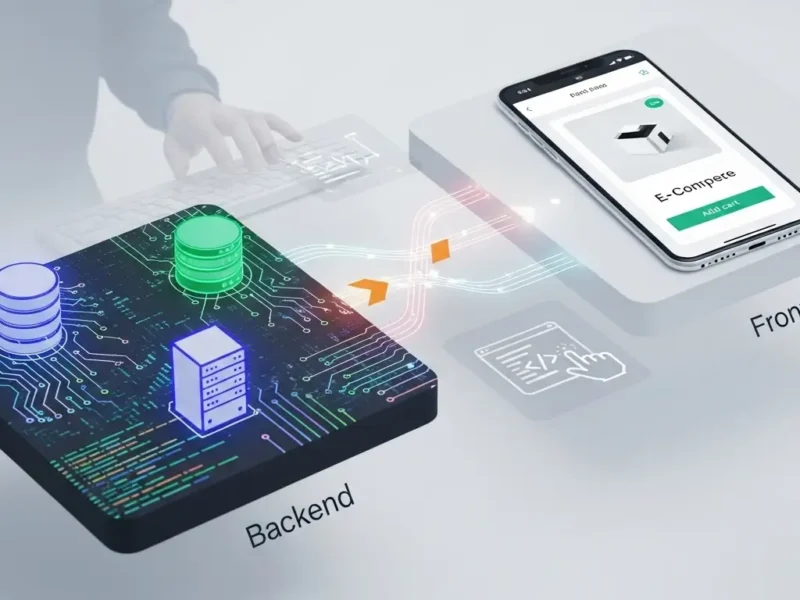
The landscape is shifting toward Headless Commerce. In this architecture, PHP handles the logic, security, and database (the “body”), while a modern JavaScript framework like Next.js handles the user interface (the “head”).
Furthermore, AI Integration is becoming standard. Using PHP to connect to OpenAI’s API or specialized machine learning tools allows you to build:
- AI-powered product recommendations.
- Automated customer support bots that know a user’s order history.
- Dynamic content generation for product descriptions.
Conclusion
PHP e-commerce development remains a top-tier choice for businesses that refuse to be limited by “standard” software. By leveraging the power of custom logic, you can build a store that not only handles transactions but actively optimizes your business operations, provides a superior user experience, and scales alongside your growth.
Whether you are building a niche boutique or a massive enterprise marketplace, the combination of PHP’s robust frameworks and custom-coded logic provides the flexibility and performance required to succeed in the modern digital economy.
Frequently Asked Questions (FAQ)
Absolutely. PHP powers the majority of the web and continues to evolve with modern features, high performance, and top-tier security. It is the foundation of major platforms like Magento and WooCommerce.
A basic custom store can take 3–5 months, while a complex enterprise-level site with extensive custom logic and integrations can take 6–12 months.
If you need a standard store with minimal customization, WooCommerce is faster to set up. If you need unique features, high scalability, and custom business logic, Laravel is the superior choice.
Yes. You can migrate data from platforms like Shopify or BigCommerce to a custom PHP backend using API-driven scripts to ensure no loss of customer or product data.
Custom logic allows you to remove friction from the buying process, offer personalized discounts, and provide a faster, more intuitive interface—all of which lead to higher sales.