 Akshay Tyagi
The global landscape has fundamentally shifted. Once-unthinkable disruptions—from a worldwide pandemic halting production to geopolitical tensions rerouting trade, and extreme weather events crippling logistics—are now commonplace. These seismic shifts have exposed critical vulnerabilities within traditional supply chains, demonstrating that outdated operational models are no longer sustainable. Companies that once thrived on lean, just-in-time approaches are now scrambling to adapt, facing unprecedented challenges in maintaining continuity, controlling costs, and meeting customer expectations.
In this new era of constant flux, supply chain resilience isn’t merely a buzzword; it’s a strategic imperative. Many businesses struggle with fragmented systems, operating with limited visibility and delayed insights, which severely hinders their ability to pivot swiftly and effectively. The solution lies not just in adopting new technologies, but in their seamless integration. This article explores how the powerful synergy of Warehouse Management Systems (WMS), Transportation Management Systems (TMS), and Enterprise Resource Planning (ERP) can build an unshakeable foundation for your business, leveraging real-time data to transform your operations. We’ll delve into what these systems are, the profound benefits of their integration, practical implementation strategies, and glimpse into the future of resilient supply chains, all designed to help you build a resilient supply chain that stands the test of time.
WMS, TMS, and ERP Explained
To truly build a resilient supply chain, we must first grasp the individual strengths of its technological pillars. Each system plays a distinct yet vital role in the intricate dance of modern logistics and business operations.
- Warehouse Management Systems (WMS):
A WMS is specialized software designed to support and optimize warehouse or distribution center operations. Its core functions include comprehensive inventory tracking, efficient management of inbound and outbound logistics, strategic space optimization, directed put-away and picking processes, and even robust labor and equipment management. By providing granular control over goods within your facility, a WMS ensures efficient movement, accurate inventory counts, and streamlined order fulfillment, significantly reducing errors and operational costs. - Transportation Management Systems (TMS):
A TMS focuses on the physical movement of goods, encompassing both inbound and outbound freight. This sophisticated platform helps businesses plan, execute, and optimize the transportation of their products. Key capabilities include dynamic route optimization, strategic carrier selection and tendering, thorough freight auditing and payment, efficient load planning, comprehensive fleet management, and real-time shipment tracking. A TMS is crucial for reducing shipping costs, improving delivery times, and ensuring compliance with transportation regulations, providing vital oversight of your goods while in transit. For companies looking to enhance their entire transportation ecosystem, exploring specialized logistics software development services can provide tailored solutions that perfectly align with unique operational needs. - Enterprise Resource Planning (ERP):
An ERP system is a comprehensive suite of integrated applications that manages a company’s core business processes. From financial management and human resources to procurement, manufacturing, and sales, an ERP system provides a holistic view of the entire organization. It consolidates data from various departments into a single, centralized database, facilitating cross-functional communication and informed strategic decision-making. Essentially, the ERP acts as the ultimate orchestrator, overseeing the entire business ecosystem.
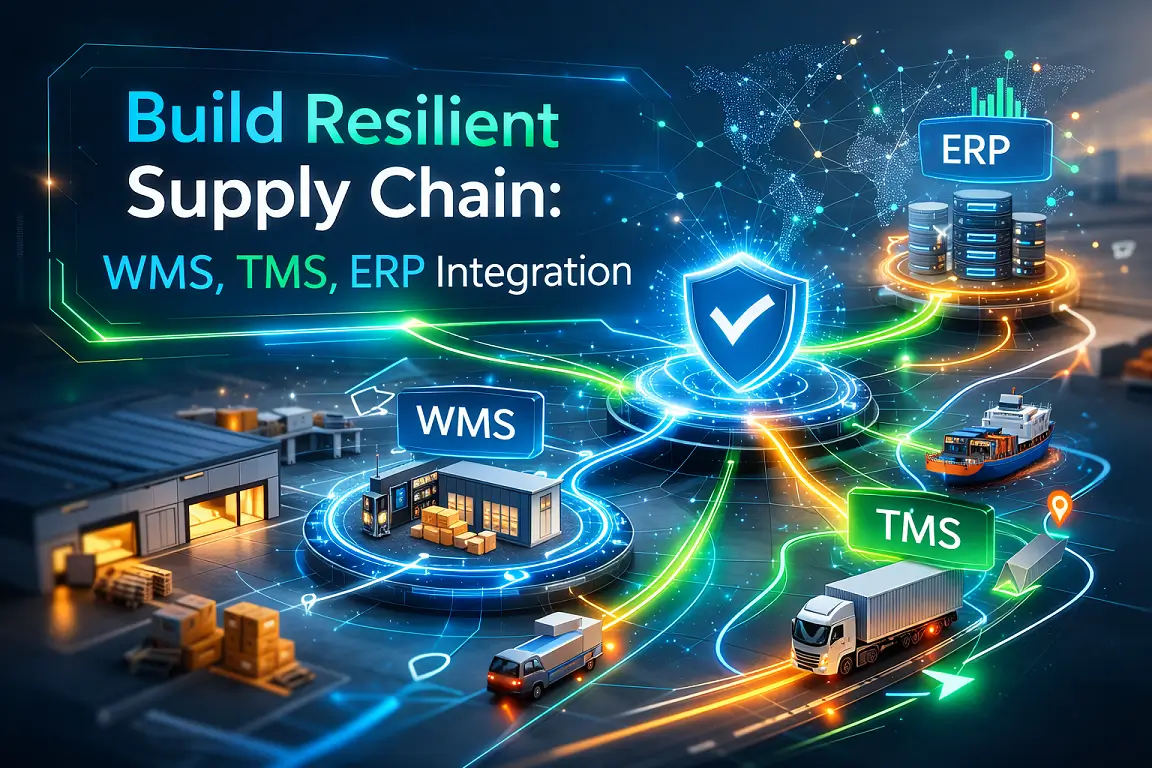
While each system is powerful on its own, their true potential for enabling supply chain resilience is unlocked through seamless integration.
The Crucial Need for WMS, TMS, and ERP Integration
The real challenge for many businesses isn’t a lack of technology, but the presence of disjointed, siloed systems. A WMS knows what’s in your warehouse, a TMS knows where your shipments are, and an ERP handles financials and overall planning. But if these systems don’t “talk” to each other, your operations face significant hurdles:
- Fragmented Visibility: Critical data gets trapped in individual departments, creating dangerous blind spots across your entire supply chain. For example, your WMS might confirm inventory, but without TMS integration, you won’t know if a truck is available to move it, or if a sudden surge in demand (tracked by ERP) is imminent.
- Delayed Decision-Making: Manual data entry, redundant efforts, and the time-consuming process of reconciling information from disparate sources hinder timely, proactive responses.
- Data Inaccuracies: More manual touchpoints increase the risk of human error, leading to incorrect inventory figures, misdirected shipments, and financial discrepancies.
- Limited Agility: Without a unified view, adapting quickly to sudden changes in demand, supply, or logistics becomes a cumbersome and slow process, costing valuable time and resources.
This is precisely why WMS, TMS, and ERP integration is no longer a luxury but an absolute necessity. When these systems are seamlessly connected, they form a unified, intelligent platform, creating a “single source of truth” for all supply chain activities. Imagine a symphony orchestra where each section (WMS, TMS, ERP) plays its part, but a conductor (the integration) ensures they play in perfect harmony. This unified approach transforms fragmented operations into a cohesive, responsive, and ultimately, resilient whole.
The Driving Force of a Resilient Supply Chain
In today’s fast-paced world, relying on historical data or daily reports is like driving a car by looking in the rearview mirror. To truly build a resilient supply chain, you need real-time supply chain data – the instant, accurate, and continuous flow of information that acts as the very heartbeat of your operations.
- Beyond Backward-Looking Data: Traditional planning often relies on past performance, which is ineffective in unpredictable markets. Real-time data empowers businesses to understand their current state and anticipate future conditions.
- How Real-time Data Transforms Operations:
- Instant Visibility: Achieve end-to-end transparency from raw material sourcing to final customer delivery. You know precisely where every item is, its status, and its expected movement at all times.
- Proactive Decision-Making: Imagine receiving an alert about a potential delay at a port, immediately understanding its impact on warehouse operations (WMS), and then swiftly rerouting shipments (TMS) to mitigate the disruption, all coordinated through your central ERP. This capability shifts your business from reactive firefighting to proactive problem-solving.
- Predictive Analytics: With real-time data streaming from integrated WMS, TMS, and ERP, advanced analytics can forecast future trends with greater accuracy. This enables better demand planning, optimized inventory levels, and the ability to model “what-if” scenarios for potential disruptions, allowing you to prepare for contingencies like sudden demand fluctuations or unexpected closures.
- Enhanced Responsiveness: When a disruption occurs, real-time data empowers rapid adjustments. If a storm closes major roads, your TMS can instantly identify affected shipments and suggest alternative routes, while your WMS adjusts picking schedules, and your ERP updates order promising dates accordingly.
The power of real-time data derived from integrated systems allows businesses to not just react to challenges, but to anticipate, mitigate, and even prevent them, significantly bolstering supply chain resilience.
The Benefits of an Integrated & Resilient Supply Chain
The integration of WMS, TMS, and ERP systems doesn’t just solve problems; it unlocks a cascade of strategic advantages that can redefine your business’s competitive edge. The benefits of an integrated supply chain extend far beyond mere operational fixes.
- Enhanced Operational Efficiency & Cost Savings:
- Reduced Waste: Accurate inventory data from WMS prevents costly overstocking and reduces obsolescence.
- Optimized Logistics: TMS route optimization minimizes fuel costs, reduces empty miles, and consolidates loads more effectively.
- Streamlined Processes: Automation of data transfer between systems eliminates manual entry, reducing labor costs and human errors.
- Minimized Penalties: Accurate deliveries and documentation reduce chargebacks and demurrage fees.
- Industry Insight: A recent logistics report highlighted that companies leveraging integrated systems often see a 15% reduction in transportation costs and a 10% decrease in inventory holding costs within the first year.
- Superior Risk Mitigation & Agility:
- Diversified Options: With comprehensive visibility, you can quickly identify alternative suppliers or transportation modes when disruptions occur.
- Faster Response to Crises: Whether it’s a natural disaster or a geopolitical event, integrated systems enable immediate impact assessment and rapid re-planning.
- Proactive Problem Solving: Real-time alerts empower you to address issues like potential stock-outs or delivery delays before they escalate into major problems, protecting your revenue and reputation.
- Improved Customer Satisfaction & Loyalty:
- Accurate Order Promising: Your sales team (ERP) can provide realistic delivery dates based on real-time inventory (WMS) and transportation capacity (TMS).
- Faster, More Reliable Deliveries: Optimized logistics translate to quicker, more consistent service.
- Proactive Communication: If a delay is inevitable, integrated systems facilitate immediate, accurate customer communication, transforming potential frustration into trust. Research indicates that 73% of customers expect proactive communications about their orders.
- Strategic Competitive Advantage:
- In a volatile market, businesses with integrated supply chain solutions become the reliable partners and preferred suppliers. Their ability to deliver consistently, adapt quickly, and offer superior service sets them apart.
- Comprehensive data empowers informed strategic planning, allowing leaders to make better decisions about expansion, product development, and market positioning. For organizations seeking tailored digital solutions to achieve these advantages, specialized supply chain software development services can craft bespoke platforms designed for ultimate efficiency and resilience.
Strategies for Successful WMS, TMS, and ERP Integration
While the benefits are clear, the journey to WMS, TMS, and ERP integration requires careful planning and execution. It’s a significant undertaking that, when managed correctly, yields immense rewards.
- Define Clear Objectives: Before embarking on any integration, clearly articulate why you’re doing it. What specific business problems are you trying to solve? What are your key performance indicators (KPIs) for success? Is it reducing lead times, cutting costs, or improving customer service?
- Adopt a Phased Approach & Prioritization: Don’t attempt to integrate everything at once. Identify the most critical integration points that will deliver the quickest wins or address the most pressing issues. A phased approach minimizes disruption and allows your team to adapt gradually.
- Establish Robust Data Governance: Data is the lifeblood of integrated systems. Implement clear rules for data input, validation, and ownership across all platforms. Inaccurate or inconsistent data will undermine the entire integration’s effectiveness.
- Strategic Vendor Selection & Compatibility: Choose systems and vendors known for their integration capabilities. Look for open APIs (Application Programming Interfaces) or pre-built connectors. Consider if a single vendor suite (e.g., an ERP with native WMS/TMS modules) or a “best-of-breed” approach (integrating specialized systems from different vendors) is best suited for your specific needs.
- Prioritize Change Management & Training: Technology is only as good as the people who use it. Prepare your employees for new workflows and provide comprehensive training. Strong leadership and clear communication are vital to foster user adoption and minimize resistance.
- Implement Strong Cybersecurity & Data Protection: Integrated systems mean more data flowing across more points. Implement robust cybersecurity measures to protect sensitive supply chain data from breaches and ensure compliance with relevant regulations like GDPR or CCPA.
- Utilize Pilot Programs & Iteration: Before a full-scale rollout, test integrations in a controlled environment. Pilot programs allow you to identify and resolve issues, fine-tune processes, and gather user feedback before impacting wider operations.
Future Trends in Supply Chain Resilience
The journey towards supply chain resilience is continuous, with new technologies constantly emerging to enhance the power of integrated systems. The future of supply chain management is already being shaped by:
- Artificial Intelligence (AI) & Machine Learning (ML): AI and ML will elevate predictive analytics, enabling even more accurate demand forecasting, autonomous decision-making in logistics (e.g., dynamic route adjustments), and predictive maintenance for warehouse equipment.
- Internet of Things (IoT): IoT devices will provide even more granular real-time supply chain data, offering insights into asset tracking, environmental conditions (temperature, humidity) during transit, and smart warehouse operations. For example, IoT sensors can prevent spoilage of temperature-sensitive goods.
- Blockchain for Transparency: Blockchain technology offers an immutable, distributed ledger for transactions, enhancing traceability, trust, and security across complex supply chains, ensuring the authenticity and provenance of goods. This is especially vital for ethical sourcing.
- Digital Twins: Creating virtual replicas of physical supply chains, including warehouses and transportation networks, allows for simulation of various scenarios, optimization of processes, and testing of disruption responses without impacting real-world operations.
These emerging technologies, when integrated with core WMS, TMS, and ERP systems, will create hyper-connected, self-optimizing, and profoundly resilient supply chains.
Conclusion
In an age defined by unpredictability, waiting for the next disruption is not a strategy; it’s a liability. True supply chain resilience is no longer a luxury but a fundamental requirement for business survival and growth. By strategically integrating your WMS, TMS, and ERP systems, you can harness the unparalleled power of real-time data, transforming your operations from reactive to predictive.
This comprehensive integration fosters unparalleled agility, drives significant operational efficiencies, and delivers substantial cost savings. More importantly, it empowers you to mitigate risks effectively, enhance customer satisfaction, and forge a powerful competitive advantage in any market condition.
Don’t let fragmented systems leave your business vulnerable. Take the first step towards building a resilient supply chain today. Assess your current technology stack, define your integration objectives, and embark on a digital transformation that will future-proof your business. Your supply chain’s future success depends on it.
Ready to transform your supply chain into a fortress of resilience? Contact us today for a personalized consultation on optimizing your WMS, TMS, and ERP integration strategy!