 Akshay Tyagi
The Software as a Service (SaaS) market has matured into the backbone of the global digital economy. The industry is accelerating toward a projected value of nearly $1 trillion by the end of the decade. However, the saturation of the market brings a sobering reality: the barrier to entry is lower than ever, but the barrier to success is higher.
For every unicorn that disrupts an industry, thousands of startups stagnate and fade away. The difference between a failed venture and a market leader rarely lies in the brilliance of the “million-dollar idea.” Instead, success relies almost entirely on execution—specifically, the rigorous adherence to a structured SaaS product development lifecycle.
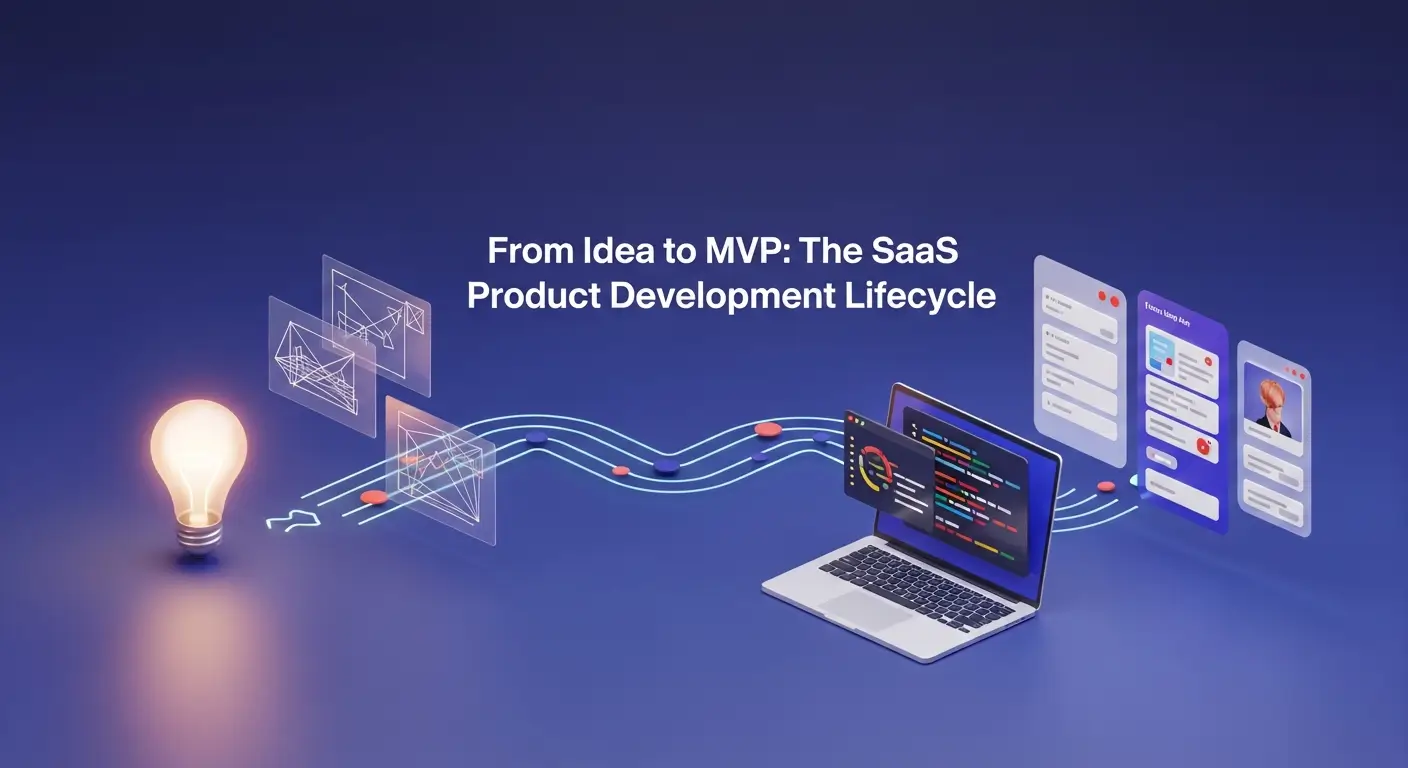
For founders, CTOs, and product managers, the journey from a napkin sketch to a functional Minimum Viable Product (MVP) is a complex navigational challenge. It requires balancing technical innovation with business viability. This guide provides a detailed roadmap of the SaaS development process, dissecting the lifecycle into actionable phases that will help you turn your vision into a scalable, revenue-generating reality.
What is the SaaS Product Development Lifecycle?
The SaaS product development lifecycle is not a linear path with a start and end date; it is a continuous loop of building, measuring, and learning. Unlike traditional software (which was often shipped once on a CD-ROM), SaaS is a living entity that requires constant evolution.
The primary goal of the early lifecycle is not to build a “perfect” product—perfection is the enemy of progress. The goal is to reach the MVP stage. An MVP is the version of a new product that allows a team to collect the maximum amount of validated learning about customers with the least amount of effort.
To navigate this journey successfully, we must break the lifecycle down into six distinct, manageable phases.
Step 1: Ideation and Validation (The “Why”)
Before a single line of code is written, and before you spend a dime on servers, you must validate that your idea solves a genuine problem. Despite rapid technological advancements, the number one reason startups fail remains “no market need.”
Identifying the Pain Point
Successful SaaS products are not just “nice to have”; they are essential painkillers. Your product must solve a specific, urgent problem for a distinct group of people. To determine this, ask:
- Is the problem frequent? Do users face this issue daily or weekly?
- Is the problem painful? Does it cost the user time, money, or significant frustration?
- Is the problem urgent? Do they need a fix now?
Deep Market Research
Once the problem is defined, you must analyze the landscape.
- Direct Competitors: Who is doing exactly what you plan to do? If there are no competitors, be wary—it might mean there is no market.
- Indirect Competitors: How are users solving this problem now? Often, your biggest competitor is a manual process or a complex Excel spreadsheet.
Validation Methods
You cannot rely on friends and family for validation; they are biased to be nice to you. You need unbiased data.
- The “Smoke Test”: Create a simple landing page describing your product (even if it doesn’t exist yet) and run paid ads to it. If people click “Sign Up” or “Join Waitlist,” you have initial interest.
- Customer Interviews: Talk to 50 potential users. Do not pitch them your idea. Instead, ask them about their current workflow and problems. If they don’t complain about the problem you want to solve, pivot immediately.
Step 2: Strategy and Planning (The “How”)
Once validated, you move from abstract ideas to concrete planning. This phase is the defense against “scope creep”—the tendency for a project’s requirements to grow uncontrollably during development.
Defining the MVP Scope via MoSCoW
To launch quickly, you must be ruthless with feature selection. Use the MoSCoW Method to prioritize:
- Must-Have: Critical features. Without these, the product is useless (e.g., a login screen, the core function).
- Should-Have: Important but not vital for launch day.
- Could-Have: Desirable features that can wait for Version 2.0.
- Won’t-Have: Features to explicitly exclude for now (e.g., Dark Mode, multi-language support).
For a SaaS MVP, focus only on the “Must-Haves.” The goal is to enter the market and gather feedback, not to release a feature-heavy enterprise suite immediately.
Choosing the Tech Stack
Your technology stack determines the scalability, performance, and cost of your application. In the modern development landscape, the standard for a robust SaaS stack often includes:
- Frontend: React, Vue.js, or Svelte for a reactive, fast user interface.
- Backend: Node.js, Python (Django/FastAPI), or Go for high-performance server-side logic.
- Database: PostgreSQL for relational data or MongoDB for unstructured data.
- Cloud Infrastructure: AWS, Google Cloud, or Azure. Serverless architectures are increasingly popular to reduce DevOps overhead.
Step 3: Design and Prototyping (The “Look”)
In the SaaS world, design is not just about aesthetics; it is about function. High churn rates are often caused by poor User Experience (UX). If a user cannot figure out how to use your tool in the first 60 seconds, they will leave.
User Experience (UX) and User Interface (UI)
- UX Design: Focuses on the user journey. Minimize the friction. How many clicks does it take to solve the core problem? The flow should be intuitive.
- UI Design: Focuses on the visual elements—colors, typography, and accessibility. Nowadays, adhering to WCAG (Web Content Accessibility Guidelines) is mandatory to ensure your product is usable by everyone.
Wireframing and Prototyping
Before coding, designers create wireframes (blueprints) and clickable prototypes using tools like Figma.
- Cost Efficiency: It is significantly cheaper to change a design in Figma than to refactor code later.
- Stakeholder Feedback: Show this prototype to potential investors or users. Does the workflow make sense to them? This is your last chance to pivot cheaply before development costs spike.
Step 4: Agile Development (The “Build”)
This is the execution phase where the SaaS product development lifecycle enters full swing. Development is the most resource-intensive phase, and how you manage it dictates your time-to-market.
The Build vs. Buy Decision
Founders often face a dilemma: should they hire an in-house team or outsource? Building an in-house team offers control but is slow and expensive (recruitment, benefits, equity). For many startups, especially those without a technical co-founder, leveraging external expertise — or even an AI co-founder to help scope and de-risk early decisions — is the smartest route. Partnering with professional SaaS product development services can bridge the gap between a concept and a deployable application, ensuring code quality and scalability without the overhead of full-time hires.
The Agile Methodology
Modern SaaS development almost universally relies on Agile methodology. Agile breaks development into short cycles called Sprints (usually 2 weeks).
- Sprint Planning: The team selects features from the backlog to build.
- Daily Standups: Short 15-minute meetings to discuss progress and blockers.
- Sprint Review: Demonstrating the completed work at the end of the cycle.
This iterative approach allows the development team to adapt to changes quickly. If user feedback shifts during development, Agile allows you to pivot without scrapping the whole project.
Integration and AI
In the current landscape, AI integration is becoming a standard expectation. Whether it is an AI agent handling support conversations or predictive analytics for the user, your development phase must account for API integrations (like OpenAI or Anthropic) and data security protocols.
Step 5: Quality Assurance and Testing (The “Polish”)
Releasing a buggy product can destroy your reputation instantly. In the era of social media, one viral complaint about data loss or downtime can kill a startup. QA is not an afterthought; it runs parallel to development.
Types of Testing Required for SaaS
- Unit Testing: Testing individual components of the code to ensure they work in isolation.
- Integration Testing: Ensuring that different modules (e.g., the payment gateway and the user database) talk to each other correctly.
- Performance/Load Testing: Can your SaaS handle 100 concurrent users? What about 10,000? You must simulate high traffic to ensure the servers don’t crash on launch day.
- Security Testing: SaaS platforms are prime targets for cyberattacks. You must test for vulnerabilities (SQL injection, XSS) to protect user data.
- User Acceptance Testing (UAT): The final step where real users test the software in a staging environment to ensure it actually solves their problem.
Step 6: Launch and Iteration (The “Release”)
You have built your MVP. Now, it’s time to go live. However, the launch is not the finish line; it is the starting gun for the growth phase.
Soft Launch vs. Hard Launch
- Soft Launch (Beta): Releasing the product to a limited audience (e.g., an email waitlist or a private community). This allows you to catch final bugs and gather testimonials in a controlled environment.
- Hard Launch: Releasing to the public via platforms like Product Hunt, social media, and PR channels. This requires a coordinated marketing push.
The Feedback Loop (Measure and Learn)
Once the product is live, you must shift focus to Product-Market Fit. Use analytics tools (like Mixpanel, Amplitude, or Google Analytics 4) to track:
- Churn Rate: Are users leaving? Where in the funnel are they dropping off?
- Activation Rate: Are users utilizing the core features?
- Customer Acquisition Cost (CAC) vs. Lifetime Value (LTV): Are you spending less to acquire a user than they pay you over time?
Collect qualitative feedback through support tickets and user interviews. Use this data to populate the backlog for the next development sprint. This returns you to Phase 2 (Strategy), creating a continuous cycle of improvement.
Why the MVP Approach Wins
Many founders resist the MVP concept because they want their product to be “perfect.” They fear that if features are missing, customers will reject them. However, the “perfect” product usually arrives too late, misses the market window, or runs out of budget before completion.
Benefits of the MVP model in the SaaS lifecycle:
- Faster Time to Market: You can launch in 3 to 6 months, rather than 18 months.
- Cost Efficiency: You don’t waste money building features nobody wants.
- Risk Mitigation: If the idea fails, it fails fast and cheap, allowing you to pivot.
- Early Revenue: You can start charging for the core value proposition immediately, funding future development.
Conclusion
The journey from idea to MVP is challenging. It requires a blend of business acumen, design thinking, and engineering excellence. However, by adhering to a structured SaaS product development lifecycle, you remove the guesswork from the equation.
Remember, your MVP is not supposed to be the final version of your vision. It is the foundation. Giants like Slack, Airbnb, and Dropbox all started as simple MVPs that looked nothing like the platforms they are today. They succeeded because they launched, they listened, and they iterated relentlessly.
Frequently Asked Questions (FAQ)
Typically, building a SaaS MVP takes between 3 to 5 months. Advancements in AI coding assistants and low-code tools have slightly accelerated this process compared to previous years, but defining the scope and ensuring security still requires time. Anything longer than 6 months suggests the scope is too broad for an MVP.
A prototype is a visualization of the product (often just design files or a clickable dummy) used for testing concepts and securing funding. It does not have functional code. An MVP is a fully functional product that works, provides value, and can be sold to customers.
While helpful, it is not strictly necessary. You can hire a development agency or a fractional CTO. However, you must have a basic understanding of the SaaS product development lifecycle to manage the project effectively and ensure you are building the right thing.
The biggest mistake is skipping validation and building in a vacuum. Founders often fall in love with their solution rather than the customer’s problem, leading to a product that works perfectly but that no one wants to buy.