 Akshay Tyagi
In the early days of online shopping, the digital storefront was a stationary destination. A customer sat at a desk, logged onto a computer, and made a purchase. Today, the consumer journey is fluid, chaotic, and omnipresent. That gateway to your store is now in pockets, on wrists, on tablets in coffee shops, and on smart TVs in living rooms. The modern shopper might discover a product on Instagram during a morning commute, research it on a laptop at work, and finally purchase it via a tablet while relaxing on the couch.
For online retailers, this multi-device behavior presents both a critical challenge and a massive opportunity. If your online store doesn’t adapt seamlessly to every screen size, you aren’t just losing traffic—you are actively turning away revenue.
Responsive web design for e-commerce is no longer just a technical feature or a cosmetic upgrade; it is the backbone of a modern digital retail strategy. In this comprehensive guide, we will explore how responsive design impacts your SEO rankings, elevates user experience (UX), and acts as a catalyst for boosting sales on any device.
The State of Mobile Commerce: Why Responsiveness is Non-Negotiable
Before diving into the technicalities, it is vital to understand the market landscape. M-commerce (mobile commerce) now accounts for nearly 73% of total e-commerce sales globally. If your store is not optimized for mobile, you are effectively ignoring three-quarters of your potential market.
However, having a site that simply “loads” on a smartphone is not enough. Users have evolved. They now expect an app-like experience on the open web. They demand lightning-fast speed, intuitive navigation, and frictionless checkout processes. If a user has to pinch-and-zoom to read a product description or struggle to tap a microscopic “Buy Now” button, they will bounce to a competitor in seconds.
The “Mobile-First” Reality of SEO
Google officially shifted to Mobile-First Indexing several years ago. This was a paradigm shift in how search engines view the web. Google predominantly uses the mobile version of your content for indexing and ranking. Even if your desktop site is a masterpiece of design, a poor mobile experience will drag down your search engine rankings across the board. Responsive design ensures that your site’s code, structure, and content remain consistent and optimized, regardless of the device accessing it.
Core Web Vitals and User Experience
Beyond basic indexing, Google’s Core Web Vitals update has made page experience a direct ranking factor. These metrics focus on loading performance (Largest Contentful Paint), interactivity (First Input Delay), and visual stability (Cumulative Layout Shift). A poorly executed mobile site often suffers from layout shifts (where buttons jump around as images load) or slow interactivity. A responsive framework is the most effective way to stabilize these metrics across all viewports.
What is Responsive Web Design in E-commerce?
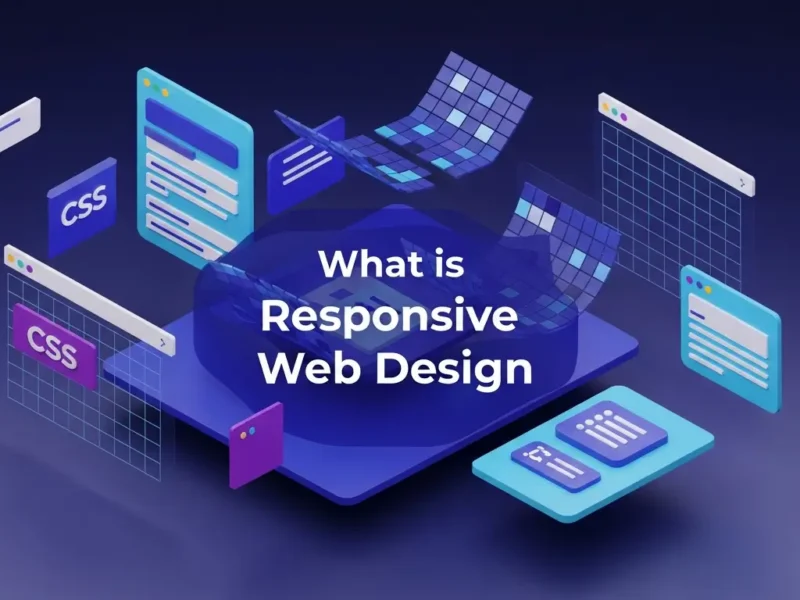
Responsive web design (RWD) is a development approach where a website’s layout changes dynamically based on the screen size and orientation of the device being used. Unlike an “adaptive” site (which detects the device and serves a separate, pre-made static layout), a responsive site uses fluid grids and flexible images.
Imagine water being poured into a cup, a bowl, and a vase. The water (your content) remains the same, but it seamlessly takes the shape of the container (the device).
Key Elements of a Responsive Store
- Fluid Grids: Elements are sized in relative units (like percentages) rather than absolute units (like pixels). This allows columns to shrink and expand proportionally.
- Flexible Visuals: Images and videos scale within their containing elements so they never overflow the screen or look pixelated.
- Media Queries: These are the CSS “checkpoints” that apply different styles based on the device’s characteristics (width, height, resolution).
- Touch-Friendly Interfaces: Navigation and inputs adapt from mouse-click interactions to touch/swipe gestures.
How Responsive Design Directly Boosts Sales
The correlation between responsive design and revenue is direct and measurable. Here is how a fully responsive architecture turns casual visitors into paying customers.
1. Reducing Friction in the Buyer’s Journey
Friction is the enemy of conversion. On a desktop, a “mega-menu” with 50 sub-categories might work well. On a mobile device, that same menu is a nightmare that covers the entire screen. Responsive design forces you to prioritize content. It implements hamburger menus, sticky headers, and simplified navigation paths that guide the user toward the checkout without distraction. By removing the barriers to browsing, you keep the user engaged longer, increasing the likelihood of a sale.
2. The “Thumb-Friendly” Zone
A crucial aspect of mobile UX is the “Thumb Zone”—the area of the screen a user can easily reach with their thumb while holding a phone one-handed. Responsive e-commerce themes place critical Call-to-Action (CTA) buttons (likeAdd to Cart,Filter Results, orCheckout) directly in this zone. When it is physically easier to buy, people buy more.
3. Faster Page Load Speeds & Reduced Abandonment
Mobile users are often on data networks (4G/5G) rather than stable Wi-Fi. Responsive design, when implemented correctly with optimized code and compressed images, contributes to faster loading times. Google studies show that as page load time goes from 1 second to 3 seconds, the probability of bounce increases by 32%. Furthermore, nearly 70% of consumers admit that page speed impacts their willingness to buy from an online retailer. Speed is a feature; responsive design helps deliver it.
4. Building Trust Through Consistency
Imagine a customer adds an item to their cart on their mobile phone during their lunch break. Later, they decide to finish the purchase on their desktop at home. If the desktop site looks completely different or functions differently than the mobile site, trust is broken. The user might wonder if they are on the correct site or if the site is secure. A responsive site offers a unified brand experience. This consistency builds the psychological trust necessary to convince users to input their credit card information.
SEO Benefits: Climbing the Search Engine Ladder
We’ve mentioned Mobile-First Indexing, but the SEO benefits of responsive design go deeper than just pleasing Google’s bots. It solves several structural issues that plague e-commerce sites.
Avoiding Duplicate Content Issues
In the past, businesses created separate mobile sites (e.g.,m.yoursite.com). This was an SEO headache. It often led to duplicate content issues, as the same product descriptions existed on two different URLs. It also split link equity (backlinks) between the mobile and desktop versions, diluting the site’s authority. Responsive design uses a single URL for all devices. This consolidates your page authority and ensures that all backlinks count toward one powerful domain.
Lower Bounce Rates and Higher Dwell Time
User signals are a significant ranking factor. If a mobile user lands on your site via a Google search and immediately leaves because the text is too small or the pop-ups are uncloseable, your bounce rate spikes. This signals to search engines that your page isn’t valuable. Conversely, a responsive site that is easy to read keeps users there longer (Dwell Time), signaling quality and relevance, which boosts your organic position.
Improved Social Sharing
A single URL also facilitates easier social sharing. If a mobile user shares a link from a responsive site to Facebook, a desktop user who clicks that link will see the desktop view, and a mobile user will see the mobile view. With separate mobile sites, a desktop user might accidentally click a “m.site” link, resulting in a terrible, stretched-out user experience that damages the brand reputation.
Best Practices for Implementing Responsive E-commerce
To truly maximize sales, simply installing a basic responsive theme isn’t enough. You must optimize the specific elements that drive conversions. While plug-and-play templates offer a starting point, many growing brands find that leveraging professional responsive web design services is the only way to ensure custom coding, complex integrations, and technical SEO requirements are handled with the precision necessary to outperform competitors.
Whether you are building in-house or outsourcing, here are the critical best practices to follow:
1. Optimize Your Media
High-resolution product photos are essential for sales, but they are heavy. Use modern formats like WebP, which offer superior compression compared to JPEGs. Implement “lazy loading,” where images only load as the user scrolls down to them. This prioritizes the loading of the “above the fold” content, keeping the initial load time lightning-fast on mobile devices.
2. Simplify Forms and Checkout
Typing on a smartphone glass screen is tedious and prone to error. Responsive checkout forms should:
- Use auto-fill capabilitiesfor addresses.
- Switch the keyboard automatically(e.g., bringing up the large numeric keypad for zip code and credit card fields).
- Reduce the number of required fieldsto the absolute minimum.
- Offer digital wallet optionslike Apple Pay, Google Pay, or PayPal to allow users to skip typing entirely.
3. Use Scalable Vector Graphics (SVGs) for Icons
Unlike JPEGs or PNGs, SVGs are code-based graphics that scale infinitely without losing quality. They are perfect for logos, cart icons, and UI elements, ensuring crisp visuals on high-resolution Retina displays without adding massive file bulk.
4. Prioritize Visual Hierarchy and Typography
On a desktop, you have the luxury of white space. On mobile, screen real estate is expensive. Use responsive typography to scale down headlines appropriately, but ensure body text remains legible (at least 16px) to prevent users from needing to zoom. Ensure yourAdd to Cartbutton is the most prominent element on the product page, utilizing contrasting colors to draw the eye.
5. Eliminate “Fat Finger” Errors
Clickable elements must have enough spacing. Google recommends touch targets be at least 48×48 pixels. If links or buttons are too close together, users will accidentally click the wrong one, leading to frustration and abandonment.
6. Test on Real Devices
Emulators in your browser are great for development, but nothing beats real-world testing. Test your store on an iPhone, an entry-level Android, an iPad, and various laptop sizes. Check for issues in direct sunlight (contrast) and with poor data connections.
Future-Proofing: Beyond Standard Responsiveness
As technology evolves, responsive design is shifting toward Progressive Web Apps (PWAs). A PWA is a website that uses modern web capabilities to deliver an app-like experience. It can send push notifications, work offline, and load instantly, all while being accessible via a standard URL.
Integrating PWA features into your responsive e-commerce strategy is the next frontier in reducing cart abandonment and increasing customer lifetime value. It combines the broad reach of the web with the high engagement of a native app.
Conclusion
Responsive web design for e-commerce is not just about making things “look pretty” on a phone. It is a strategic necessity for conversion rate optimization, SEO dominance, and brand reputation. In a world where the customer is always moving, your storefront must be fluid enough to move with them.
By prioritizing a mobile-first approach, optimizing for speed, and ensuring a frictionless checkout experience across all devices, you position your brand to capture every possible sale. Don’t let your website be the bottleneck in your business growth.