 Akshay Tyagi
The digital landscape is no longer shifting; it has fundamentally changed. For decades, the “enterprise software” narrative was dominated by monolithic ERPs, rigid workflows, and multi-year implementation cycles. Today, that model is obsolete. In its place, a new triad of technological power is emerging to redefine how businesses operate, innovate, and grow.
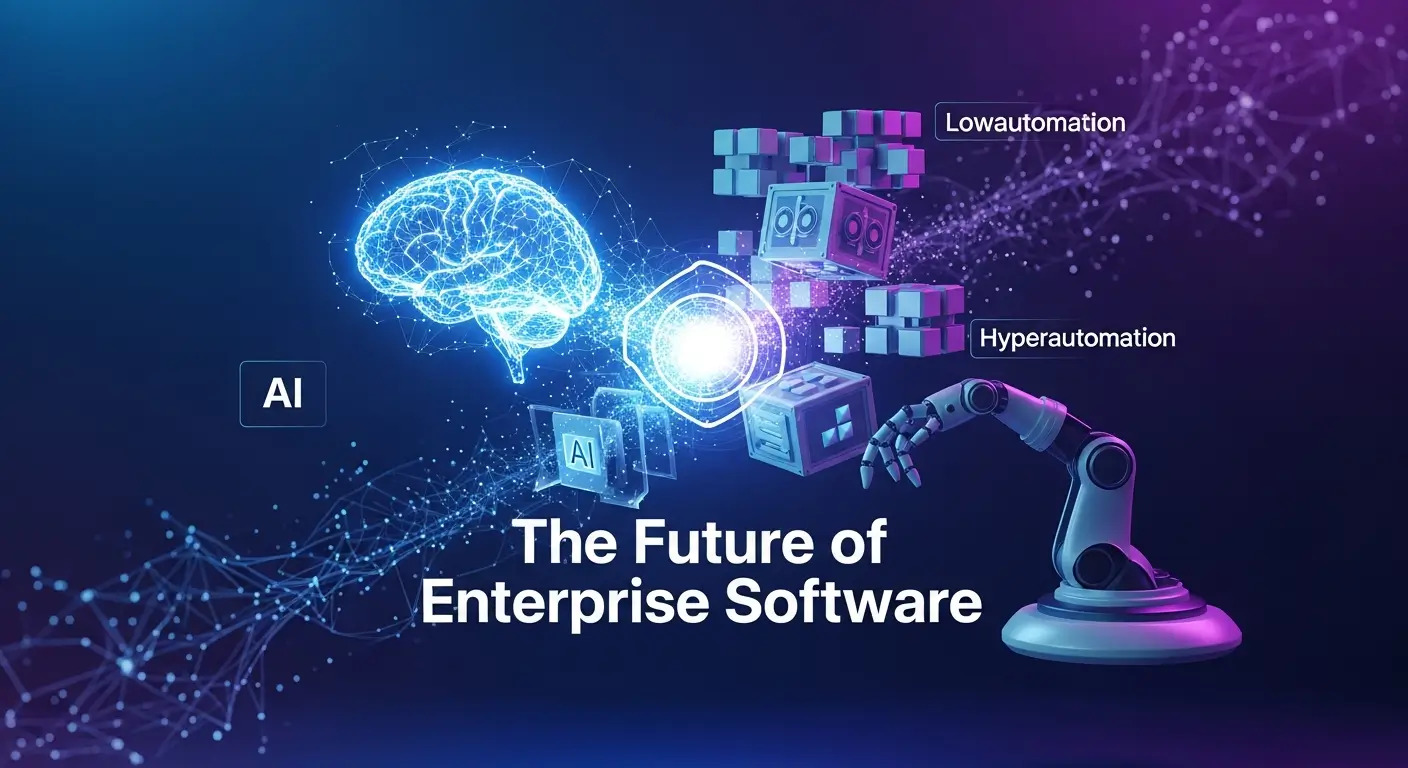
We are witnessing the convergence of Hyperautomation, Artificial Intelligence (AI), and Low-Code development platforms.
This isn’t just a trend for the IT department. It is a strategic imperative for C-level executives, operations managers, and stakeholders across the board. The future of enterprise software is not about buying a better tool; it is about building a composable, autonomous, and agile business infrastructure.
In this article, we will explore how these three pillars are revolutionizing the corporate world, the synergy they create when combined, and how your organization can leverage them to secure a competitive advantage in the coming decade.
1. The Great Convergence: Why Now?
Before diving into the technologies, we must understand the catalyst. The post-2020 business environment introduced the “need for speed” as a survival metric. Organizations faced sudden shifts in supply chains, remote work mandates, and fluctuating consumer demands.
Legacy systems simply couldn’t keep up. The result was a massive acceleration in digital transformation.
Enter the “Holy Trinity” of modern tech stack evolution:
- Hyperautomationallows for speed and scale.
- AIprovides intelligence and decision-making capabilities.
- Low-Codedemocratizes creation, allowing non-technical staff to build solutions.
Together, they form a self-sustaining ecosystem that reduces technical debt and accelerates time-to-market.
2. Hyperautomation: The End of “Task” Automation
For years, businesses relied on basic automation or Robotic Process Automation (RPA) to handle repetitive, rule-based tasks—like copying data from an email to a spreadsheet. While useful, RPA is limited; it breaks when processes change and cannot “think.”
Hyperautomation is the next evolutionary step. It is not a single technology, but a strategic approach that involves automating as many business and IT processes as possible.
Moving Beyond RPA
Hyperautomation orchestrates multiple technologies, including RPA, AI, machine learning (ML), and process mining.
- Process Mining: Before automating, software analyzes logs to see how workactuallygets done, identifying bottlenecks human managers might miss.
- End-to-End Orchestration: Instead of automating a single task, hyperautomation handles the entire workflow—from the initial customer query to the final invoice generation.
The Business Impact
By adopting hyperautomation strategies, enterprises can expect:
- Reduced Operational Costs: Gartner predicts that by 2024, organizations will lower operational costs by 30% through combining hyperautomation technologies with redesigned operational processes.
- Error Reduction: eliminating the “fat finger” errors associated with manual data entry.
- Scalability: Digital workers (bots) can be scaled up instantly during peak seasons without the lag time of hiring and training human staff.
3. Artificial Intelligence: The Brain of the Enterprise
If Hyperautomation is the muscle, Artificial Intelligence is the brain. The future of enterprise software relies on AI moving from a “feature” to the “foundation.” We are transitioning from systems that merely record data (Systems of Record) to systems that understand and act on data (Systems of Intelligence).
Generative AI and Large Language Models (LLMs)
The explosion of Generative AI (like ChatGPT and its enterprise equivalents) has changed the game. Enterprise software can now generate code, write marketing copy, summarize legal documents, and analyze complex datasets using natural language prompts.
Predictive vs. Reactive
Traditional software is reactive:“Inventory is low; send an alert.”
AI-driven software is predictive:“Based on seasonal trends and current supply chain disruptions, inventory will be low in 14 days. Creating a purchase order now for approval.”
Key AI Applications in Enterprise:
- Intelligent Document Processing (IDP): Reading unstructured data (PDFs, images) and converting it into structured database entries.
- Customer Sentiment Analysis: Analyzing support tickets to gauge brand health in real-time.
- Dynamic Resource Allocation: AI algorithms automatically shifting server loads or workforce schedules based on predicted demand.
4. Low-Code/No-Code: The Rise of the Citizen Developer
Perhaps the most disruptive trend in enterprise software is the democratization of development. For decades, if a marketing manager needed a custom application to track leads, they had to submit a ticket to IT and wait six months.
Low-Code and No-Code (LCNC) platforms have shattered this barrier.
Solving the IT Talent Gap
There is a global shortage of skilled software engineers. LCNC platforms allow users with little to no coding experience to build applications using visual drag-and-drop interfaces.
However, it is important to note the distinction in complexity. While citizen developers can handle departmental workflows and dashboards, the need for professional enterprise software development services remains critical. Organizations still rely on expert developers to build the secure, scalable backbone and complex integrations that support these low-code applications, ensuring that “easy access” does not lead to “architectural chaos.”
The “Citizen Developer” Revolution
A “Citizen Developer” is an employee who creates application capabilities for consumption by themselves or others using tools that are not actively forbidden by IT or business units.
- Agility: A department can build, test, and deploy a specific tool in days, not months.
- Cost Efficiency: Reduces the spend on expensive external consultants for minor app development.
- Alignment: The people building the software are the subject matter experts who will actually use it, ensuring the final product meets business needs perfectly.
5. The Synergistic Effect: How They Work Together
The true power lies not in using these technologies in isolation, but in their convergence. This serves as the backbone of the Composable Enterprise.
A Real-World Scenario: The Intelligent Onboarding Process
Imagine a global enterprise hiring a new employee. Here is how the triad works in unison:
- Low-Code Interface: HR uses a custom-built low-code app to input the new hire’s details. The app was built by the HR team to match their specific compliance needs.
- Hyperautomation Orchestration: Once the form is submitted, a hyperautomation bot triggers. It automatically provisions the employee’s email, Slack account, and access to the CRM.
- AI Integration: The system scans the employee’s resume and role description using AI. It suggests a personalized learning path in the Learning Management System (LMS) and assigns a mentor based on shared skills and psychological profiles.
- Feedback Loop: As the employee progresses, the AI analyzes their performance data. If they struggle, the system automatically alerts the manager and suggests resources—all without human administrative intervention.
This is the future: seamless, intelligent, and automated.
6. Overcoming the Challenges of Implementation
While the future looks bright, the path to adoption is not without hurdles. Enterprise leaders must navigate several risks to successfully implement this tech stack.
Shadow IT and Governance
When you empower everyone to be a developer (Low-Code), you risk “Shadow IT”—software built without IT oversight. This can lead to security vulnerabilities and data silos.
- Solution: Implement strong governance frameworks. IT should control theplatformand security protocols, while business units control theapplicationlogic.
Data Privacy and Security
AI and Hyperautomation thrive on data. However, feeding sensitive enterprise data into public AI models is a major security risk.
- Solution: Invest in private LLMs and ensure all automation workflows are encrypted and compliant with GDPR, CCPA, and SOC2 standards.
The Cultural Shift
Employees often fear that “automation” means “termination.”
- Solution: Change the narrative. Position these tools as “co-pilots” that remove drudgery, allowing humans to focus on creative, strategic, and empathetic work—things AI cannot do. Upskilling is essential.
7. The Road Ahead: Predictions for 2030
As we look toward the next decade, the enterprise software market will continue to evolve rapidly.
- The Autonomous Enterprise: We will move from “human-in-the-loop” to “human-on-the-loop.” Software will manage standard operations autonomously, only alerting humans for exceptions or strategic pivots.
- Software that Writes Software: AI will become so advanced that Low-Code will evolve into “No-Code-at-all,” where users simply speak a request (“Build me a CRM for real estate agents”) and the AI constructs the application instantly.
- Hyper-Personalization: Internal enterprise software will become as user-friendly and personalized as consumer apps (like Netflix or TikTok), adapting interfaces to the specific working style of the employee.
Conclusion
The future of enterprise software is not a distant dream; it is being written today in lines of code, automated workflows, and neural networks. The convergence of Hyperautomation, AI, and Low-Code offers a path out of technical debt and into a future of unprecedented agility.
Organizations that cling to legacy models risk obsolescence. Those that embrace this triad will not only survive operational challenges but will thrive, innovating faster than the competition and delivering superior value to their customers.
The tools are ready. The question is: Is your business ready to use them?
Take the Next Step in Your Digital Transformation
Navigating the complexities of AI and automation can be daunting, but you don’t have to do it alone. Whether you are looking to streamline your workflows, empower your team with low-code solutions, or integrate cutting-edge AI, the time to act is now.
Contact Us Today for a Free Consultation to assess your current tech stack and discover how we can help you build the enterprise of the future. Don’t let the future automate you out of existence—automate your way to the top.