 Akshay Tyagi
In today’s hyper-digital landscape, e-commerce isn’t just an option; it’s a necessity. Businesses worldwide have embraced online selling, transforming how products and services reach customers. But for companies embarking on or refining their digital storefronts, the platform they build depends entirely on who they’re selling to. Are you selling to other businesses (B2B) or directly to consumers (B2C)? Many mistakenly believe that e-commerce is a one-size-fits-all solution, an oversight that can lead to inefficient operations, frustrated customers, and missed revenue opportunities.
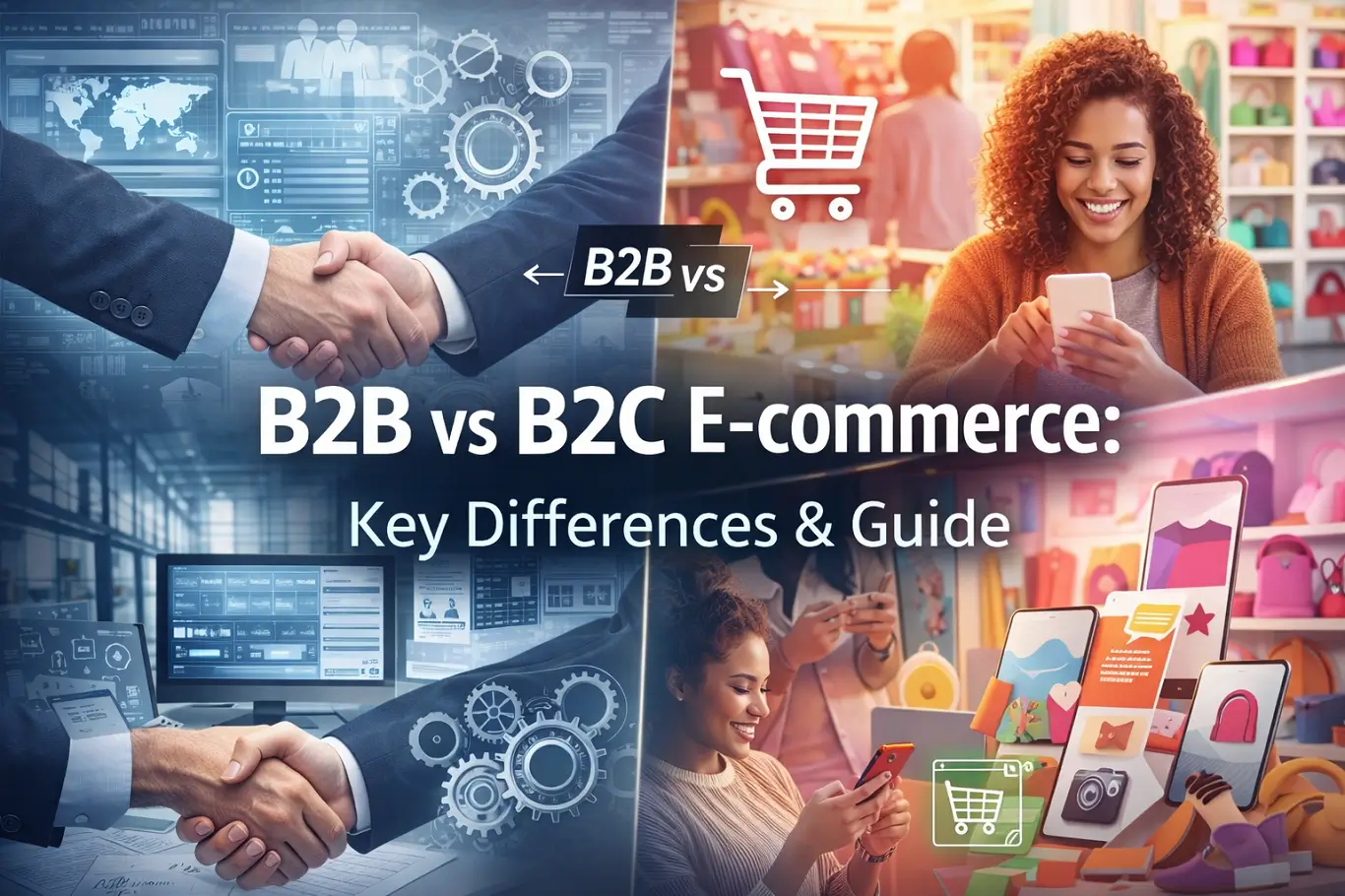
This article will meticulously break down the fundamental distinctions between B2B and B2C e-commerce solutions, exploring everything from customer behavior and platform features to marketing strategies and operational complexities. By the end, you’ll clearly understand which e-commerce model aligns with your business goals and how to select the optimal platform to drive sustainable growth. We’ll delve into key differences in the customer journey, functionality, pricing, user experience (UX), and more, empowering you to make informed strategic decisions for your digital commerce future.
I. Understanding the Core Audiences: B2B vs. B2C Customer Journey
At the heart of any successful e-commerce strategy lies a deep understanding of the customer. The B2B vs. B2C customer journey diverges significantly, dictating everything from website design to sales outreach.
A. The B2B Buyer: Rational Decisions, Complex Processes
The business-to-business (B2B) buyer is fundamentally different from a consumer. Their motivations are rational and needs-driven, primarily focused on ROI, efficiency, and solving specific operational challenges. The B2B customer journey is often characterized by:
- Complex Decision-Making: Purchases involve multiple stakeholders—procurement, department heads, IT, finance, and senior management—each with unique criteria and approval processes.
- Longer Sales Cycles: B2B sales cycles can span weeks or even months due to the complexity, customization required, and the high value of transactions.
- Relationship-Driven: B2B transactions are often built on long-term relationships, contracts, and repeated bulk orders, emphasizing trust and reliability.
- Critical Operational Impact: Purchase decisions are crucial to business operations, making risk aversion a significant factor.
A typical B2B customer journey involves extensive research, quote requests, negotiation, multiple approval cycles, purchase, and ongoing post-purchase support and reordering. For example, a manufacturer buying raw materials needs a reliable supplier with consistent quality and specific delivery schedules, often managed through a dedicated account.
B. The B2C Shopper: Emotional Connections, Instant Gratification
In contrast, the business-to-consumer (B2C) shopper’s journey is often more spontaneous and emotionally driven, focused on immediate gratification, convenience, and personalization. Key characteristics of the B2C customer journey include:
- Individual Decision-Makers: Purchases are typically made by one person, often influenced by personal preferences, branding, peer reviews, and social media trends.
- Shorter Sales Cycles: From discovery to purchase, the B2C journey can be remarkably quick, sometimes taking mere minutes.
- Value Experience & Aesthetics: Consumers value visually appealing interfaces, intuitive user experience (UX), and seamless navigation.
- Lower Transaction Value, Higher Frequency: While individual purchases are generally smaller, consumers often make more frequent transactions.
The B2C customer journey often starts with discovery through social media, advertisements, or search engines, followed by browsing, comparison, adding to cart, and a quick, frictionless checkout. Think of buying a new pair of headphones online – the decision might be quick, driven by features, reviews, and a desire for immediate enjoyment.
II. Distinctive Platform Functionality: What Each Solution Needs to Succeed
The underlying technology and features of an e-commerce platform must cater specifically to these distinct customer journeys. B2B e-commerce platform features are engineered for complexity, while B2C e-commerce functionality prioritizes simplicity and engagement.
A. Essential B2B E-commerce Platform Features:
B2B platforms are robust systems designed to handle intricate business logic. They typically include:
- Advanced Account Management & Self-Service: Features like customer-specific catalogs, negotiated pricing tiers, multi-user accounts with role-based permissions, comprehensive order history, and easy reorder functionality.
- Complex Pricing & Quoting: The ability to manage tiered pricing, volume discounts, custom quotes, credit limits, and diverse payment terms (e.g., Net 30/60).
- Streamlined Ordering: Tools for bulk order entry, quick order forms, SKU import capabilities, PunchOut integration (for procurement systems), and recurrent order management.
- Robust Integration Capabilities: Seamless APIs for connecting with critical back-office systems like ERP (Enterprise Resource Planning), CRM (Customer Relationship Management), PIM (Product Information Management), and accounting software (e.g., SAP, Salesforce, Microsoft Dynamics).
- Sales Team Enablement: Functionality that allows sales representatives to access customer accounts, generate quotes, and place orders on behalf of their clients, enhancing efficiency.
Case Study Example: A large industrial equipment supplier implemented a B2B portal. This allowed their diverse clientele—from small workshops to large corporations—to access customized product catalogs and pricing, reducing reliance on manual sales processes and empowering distributors with self-service ordering, drastically cutting down administrative overhead.
B. Crucial B2C E-commerce Functionality:
B2C platforms, conversely, focus on captivating individuals and simplifying their shopping experience. They emphasize:
- Intuitive User Experience (UX) & Design: Visually appealing, brand-consistent interfaces that are mobile-responsive and offer seamless navigation.
- Personalization & Recommendations: AI-driven product suggestions, personalized content, targeted promotions, and robust abandoned cart recovery features.
- Marketing & Merchandising Tools: Sophisticated engines for promotions, discounts, loyalty programs, gift cards, and rich product descriptions with high-quality images and videos.
- Customer Engagement: Features like wishlists, comprehensive customer reviews & ratings, Q&A sections, and seamless social media integration.
- Effortless Checkout: One-page or guest checkout options, and a wide array of payment methods (digital wallets, installment plans) to minimize friction.
Case Study Example: A popular online fashion retailer leveraged advanced personalization engines within their B2C platform. By analyzing browsing history and purchase patterns, they offered highly relevant product recommendations and dynamic content, significantly boosting conversion rates and customer lifetime value.
C. Overlapping & Hybrid Features:
Despite their differences, both models share fundamental e-commerce needs: secure payment gateways, efficient inventory management, reliable shipping logistics, robust analytics for insights, and foundational SEO tools.
III. Pricing, Payments, and Fulfillment: Key Operational Distinctions
The operational backbone of B2B vs. B2C e-commerce solutions – encompassing pricing, payment processing, and fulfillment – also varies considerably.
A. B2B Transaction & Payment Processing:
B2B e-commerce payments are inherently more complex. They often involve:
- Diverse Payment Methods: Purchase Orders (POs), established credit accounts, wire transfers, ACH, and sometimes large credit card transactions. Cash flow management is critical.
- Custom Pricing Structure: Highly customized, often negotiated, volume-based, and subject to contract pricing, requiring dynamic pricing engines.
- Complex Invoicing & Reconciliation: Intricate invoicing needs, deep integration with accounting systems, and managing deferred payment terms.
- Data/Sources: Surveys consistently show that B2B buyers prefer credit terms and POs over immediate payment.
B. B2C Transaction & Payment Processing:
B2C focuses on ease and speed:
- Convenient Payment Methods: Dominantly credit/debit cards, PayPal, Apple Pay, Google Pay, and increasingly, “buy now pay later” options (e.g., Affirm, Klarna).
- Fixed Pricing Structure: Fixed, transparent, and often includes promotional pricing that applies to all customers.
- Optimized Checkout Flow: Designed for speed, security, and convenience to minimize cart abandonment.
C. Fulfillment & Logistics:
- B2B: Typically involves larger, less frequent shipments – pallet loads, freight, and scheduled deliveries. Warehousing and logistics are often highly complex, dealing with bulk orders and specific receiving requirements.
- B2C: Focuses on parcel shipping, offering diverse delivery options (standard, express, same-day), robust tracking, and efficient last-mile delivery to individual consumers.
IV. Marketing, Sales, and Customer Service: Tailored Strategies
The approach to engaging customers through marketing, sales, and support also starkly differentiates B2B e-commerce marketing from B2C customer service.
A. B2B Marketing & Sales Strategies:
- Marketing: Highly targeted content marketing (whitepapers, case studies, webinars), Account-Based Marketing (ABM), lead generation campaigns, active presence on LinkedIn, and industry events. SEO focuses on technical terms and solutions.
- Sales: Direct sales team involvement is crucial, emphasizing relationship building, consultative selling, product demos, and dedicated account managers.
- Customer Service: Dedicated account representatives, technical support specialists, and robust ticketing systems manage long-term relationships and complex issue resolution.
B. B2C Marketing & Sales Strategies:
- Marketing: Broad reach via SEO, social media marketing (Instagram, TikTok), PPC advertising, email marketing campaigns, influencer marketing, and affiliate programs, with a focus on emotional branding.
- Sales: Primarily driven by an intuitive website UX, compelling promotions, engaging product presentation, and positive customer reviews.
- Customer Service: Characterized by live chat, AI-powered chatbots, extensive FAQs, social media support, and a strong emphasis on quick issue resolution and hassle-free returns.
V. The Rise of Hybrid Models & Headless Commerce for Future-Proofing
The digital landscape is constantly evolving, and for many businesses, the lines between B2B and B2C are blurring. This is where hybrid e-commerce and headless commerce B2B B2C come into play.
A. When B2B and B2C Lines Blur: The Hybrid E-commerce Model
Many companies find themselves operating in both arenas. A manufacturer might sell components to other businesses (B2B) while also offering finished products directly to consumers (B2C). These “hybrid” businesses face unique challenges in managing inventory, customer data, and distinct marketing efforts from potentially disparate systems.
B. The Power of Headless & Composable Commerce:
This is where headless commerce offers a transformative solution. Instead of a traditional monolithic e-commerce platform where the front-end (what customers see) and back-end (business logic, data) are tightly coupled, headless commerce decouples them. It allows businesses to use a single, powerful back-end engine while deploying multiple, customized front-end experiences. For complex projects, partnering with an experienced web development company in Noida can ensure seamless integration and optimal performance of such advanced architectures.
- Benefits for Hybrid Models: Headless provides the flexibility to create distinctly tailored user experiences for B2B buyers (e.g., a functional, self-service portal) and B2C consumers (e.g., an aesthetic, personalized shopping site) using the same underlying product data, inventory, and order management. This enables faster innovation, easier integration with new technologies, and a unified view of the business.
- Analogy: Think of traditional e-commerce as a pre-built house – it’s functional, but making significant structural changes is difficult. Headless commerce is like building with LEGOs – you have a strong foundation (the back-end) but can easily reconfigure the exterior (the front-end) to suit different needs or preferences, such as having both a B2B and a B2C storefront using the same robust commerce engine.

C. Key Considerations for Adopting Hybrid/Headless Commerce:
While the promise of hybrid and headless architectures is significant, their adoption requires strategic foresight. Businesses must carefully evaluate scalability needs to ensure the platform can handle future growth in both B2B and B2C transactions. A clear understanding of the budget—not just for initial development but for ongoing maintenance and future enhancements—is crucial. Furthermore, the availability of technical expertise within the team or through agency partnerships is paramount for successful implementation and management. Ultimately, a well-defined long-term digital commerce vision is essential to maximize the benefits of these flexible, yet complex, solutions.
VI. Choosing the Right E-commerce Solution: A Strategic Framework for Success
Given the profound differences, how do you go about choosing an e-commerce platform that truly fits your business? Here’s a strategic framework:
A. Define Your Business Goals & Target Audience:
- Who are your primary customers? Are you selling exclusively B2B, B2C, or both?
- What are their unique needs, pain points, and buying behaviors?
- What are your immediate and long-term growth projections?
B. Evaluate Essential Features & Integrations:
- Create a detailed list of “must-have” functionalities. For B2B, this might include custom pricing, PO support, and ERP integration. For B2C, focus on personalization, strong merchandising, and a seamless checkout.
- Consider how well the platform integrates with your existing business systems (CRM, ERP, PIM, marketing automation).
C. Assess Budget & Scalability:
- Analyze both upfront costs (licensing, development, setup) and ongoing expenses (maintenance, hosting, transaction fees, support).
- Crucially, assess the platform’s ability to scale with your business – can it handle increasing transaction volumes, a growing product catalog, and expanding customer bases without requiring a complete overhaul?
D. Prioritize User Experience (UX) & Design:
- Does the platform allow for the specific UX your target audience expects and demands? A B2B site should prioritize efficiency and functionality, while a B2C site needs to be visually engaging and intuitive.
E. Review Vendor Support & Ecosystem:
- Research the reputation of the platform provider, the strength of their developer community, and the availability of apps, plugins, and integration partners. For many businesses, collaborating with a dedicated ecommerce development agency can provide the specialized expertise needed to navigate these choices and build a thriving online store.
Conclusion
The digital commerce landscape offers immense opportunities, but success hinges on a fundamental understanding of your target audience. The distinctions between B2B and B2C e-commerce solutions are not merely technical specifications; they represent divergent philosophies in sales, marketing, customer service, and operational management.
Choosing the correct e-commerce solution is not just a technical decision, but a fundamental strategic move that impacts every facet of your business. By thoroughly understanding your customer’s journey, identifying essential platform features, planning for operational complexities, and evaluating future-proofing options like headless commerce, you can select an optimal platform. The right e-commerce solution is a powerful investment in your company’s digital future, enabling you to deliver exceptional experiences and drive sustainable growth.
Ready to transform your online presence? Don’t navigate the complexities of B2B and B2C solutions alone. Contact us today for a personalized consultation to build a platform designed for your unique success and unlock your full e-commerce potential!
You Might Also Like