 Sumit Yadav
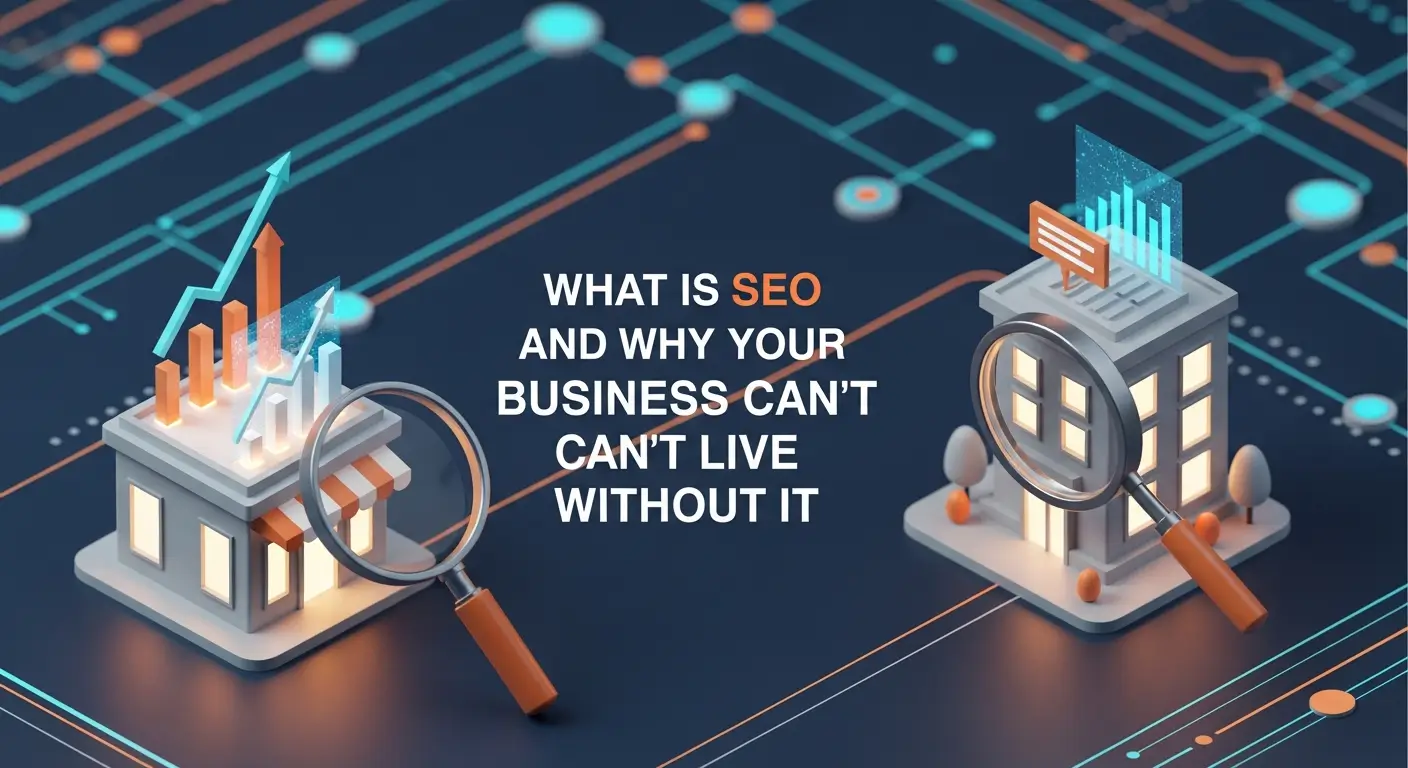
Imagine you have just built the most magnificent retail store in your city. The interior design is stunning, the products are revolutionary, and your staff is world-class. However, there is one major problem: you built this store in a hidden underground bunker with no signage, no map listing, and no roads leading to it.
How many customers will you get? Likely zero.
This analogy perfectly describes a business website without Search Engine Optimization (SEO). In the digital landscape, your website is your storefront. If Google, Bing, and other search engines cannot find, crawl, and index your site, you are essentially invisible to your potential customers.
In an era where 53% of all trackable website traffic comes from organic search, ignoring SEO is akin to leaving money on the table. But what exactly is SEO, and why is it the oxygen your business needs to survive and thrive?
Demystifying the Acronym: What is SEO?
SEO stands for Search Engine Optimization. In its simplest form, it is the practice of improving your website to increase its visibility when people search for products or services related to your business in Google, Bing, and other search engines.
The better visibility your pages have in search results, the more likely you are to garner attention and attract prospective and existing customers to your business.
To understand SEO fully, we must break it down into its three core pillars. A successful SEO strategy isn’t just about keywords; it is a holistic approach to website health.
1. On-Page SEO (Content)
This relates to the content on your website. It involves optimizing individual web pages to rank higher and earn more relevant traffic. This includes:
- Keyword research: Identifying terms your audience uses.
- Content creation: Writing high-quality, helpful blog posts and landing pages.
- HTML tags: Optimizing title tags, meta descriptions, and headers (H1, H2, H3).
2. Technical SEO (Structure)
This refers to the non-content elements of your website. It improves a site’s backend structure and foundation. Technical SEO ensures that search engine spiders can crawl and index your site without issues. Key factors include:
- Site speed: How fast your pages load.
- Mobile-friendliness: How well your site performs on smartphones.
- Site architecture: A logical URL structure and secure connection (HTTPS).
3. Off-Page SEO (Authority)
This focuses on increasing the authority of your domain through the act of getting links from other websites. This tells search engines that your site is valuable and high-quality. This is primarily achieved through:
- Backlinks: When other reputable sites link to yours.
- Social media marketing: Driving traffic and brand awareness.
- Guest blogging: Writing for other industry publications.
How Search Engines Actually Work
To master SEO, you must understand the goal of the search engine (like Google). Google’s primary goal is to provide the best possible answer to a user’s query in the fastest possible time.
Search engines work through three primary steps:
- Crawling: Search engines send out bots (often called spiders or crawlers) to find new or updated content.
- Indexing: The search engine stores and organizes the content found during the crawling process. Once a page is in the index, it is in the running to be displayed as a result to relevant queries.
- Ranking: This is the piece that businesses care about most. When someone performs a search, the search engine scours its index for highly relevant content and orders that content in the hopes of solving the searcher’s query.
7 Reasons Why Your Business Can’t Live Without SEO
You might be thinking, “Can’t I just pay for ads?” While Pay-Per-Click (PPC) has its place, it is a short-term fix. SEO is a long-term asset. Here is why your business cannot survive—or at least cannot scale efficiently—without it.
1. Organic Search is the Primary Source of Web Traffic
For most businesses, organic search is a massive part of their website performance, as well as a critical component of the buyer funnel. As mentioned earlier, over half of all web traffic comes from organic search. If you aren’t ranking, you are handing 50% of your potential market share directly to your competitors who are ranking.
2. SEO Builds Trust and Credibility
Users trust Google. When you search for a solution to a problem, you intuitively trust the results on the first page. You assume that if Google put them there, they must be a reputable authority.
Ranking high signals to customers that you are a key player in your industry. Conversely, if your business is buried on page two or three, it generates skepticism. A strong SEO strategy establishes your E-E-A-T (Experience, Expertise, Authoritativeness, and Trustworthiness), which is crucial for converting visitors into buyers.
3. It Offers the Best ROI in Advertising
SEO is an inbound marketing strategy. This means it connects you with people who are actively looking for what you offer. This is the opposite of “outbound” or “interruptive” marketing like cold calling or TV ads, which interrupt people who may not be interested.
Because you are targeting users who are already in the market for your product or service (high search intent), the conversion rates for SEO leads are significantly higher than traditional marketing. While SEO requires an investment—be it your internal team’s time or the budget for hiring an SEO agency—it is technically “free” regarding cost-per-click. Unlike paid ads, where the traffic stops the moment you stop paying, SEO content can drive traffic for years after it is published.
4. Local SEO Drives Physical Conversions
With the rise of mobile traffic, local search has become fundamental to the success of small and medium-sized businesses.
Think about the last time you needed a service. You probably searched for “plumber near me” or “best italian restaurant in [City Name].”
- Local SEO optimizes your digital properties for a specific vicinity, so people can find you quickly and easily, putting you one step closer to a transaction.
- Optimizing your Google Business Profile (formerly Google My Business) is vital here. It ensures your hours, location, and reviews are front and center.
Stat to know: 76% of people who search on their smartphones for something nearby visit a business within a day.
5. SEO Improves User Experience (UX)
Many business owners do not realize that good SEO naturally leads to a better User Experience. Google’s algorithms have become smart enough to interpret whether a user had a good time on your site.
If your site loads slowly, is hard to navigate, or looks terrible on a mobile phone, users will “bounce” (leave immediately). High bounce rates signal to Google that your site is low quality, and your rankings will drop. By optimizing your site for speed and mobile usability (technical SEO), you are inadvertently creating a smoother, more enjoyable experience for your human visitors.
6. It Impacts the Buying Cycle
Customers do their research. That is one of the biggest advantages of the internet from a buyer’s perspective. They use search tactics to investigate your competitors, compare prices, and read reviews.
If you use content marketing (a subset of SEO) to create informative articles, buying guides, and comparison charts, you can influence the buyer at every stage of their journey. When your brand provides the answers to their questions, you build a relationship before they even speak to a sales rep.
7. Your Competitors Are Already Doing It
This is perhaps the most pragmatic reason of all. Search engine optimization is not a new fad; it is a standard business practice. If your competitors are investing in SEO and you are not, they will appear above you in search results.
In the digital world, the winner takes all. The first result on Google gets nearly 30% of all clicks. The drop-off after the first few results is precipitous. If you aren’t fighting for those spots, you aren’t just losing traffic; you are losing relevance.
SEO vs. SEM: The “Rent vs. Own” Analogy
To fully grasp the value of SEO, it helps to compare it to SEM (Search Engine Marketing) or PPC ads (like Google Ads).
- PPC is like renting an apartment. You pay a premium to live in a great spot (the top of the search results). It is fast and effective, but the second you stop paying rent, you are kicked out. You own no equity in that position.
- SEO is like buying a house. It requires a down payment (initial effort/audit) and monthly maintenance (content creation/link building). It takes time to build. However, once you rank, that “real estate” is yours. You own the traffic it generates, and over time, the asset increases in value while the cost per visitor decreases.
Ideally, a mature marketing strategy uses both, but your business cannot survive on “renting” traffic forever. You must build equity.
Getting Started: A Simple Roadmap
If you are convinced that your business needs SEO, where do you start? Here is a simplified roadmap for the next 30 days:
- Audit Your Site: Use tools like Google Search Console or Ubersuggest to see where you currently stand. Are there broken links? Is your site mobile-friendly?
- Claim Your Google Business Profile: Ensure your name, address, and phone number (NAP) are consistent across the web.
- Keyword Research: Identify 5-10 core keywords that describe your services. Do not just guess; use tools to find what people are actually typing.
- Create Content: Write one comprehensive article per week answering a specific question your customers have.
- Optimize On-Page: Ensure your target keywords are in your page titles and headers.
Conclusion: SEO is Not Optional
In the modern business landscape, questioning the value of SEO is like questioning the value of having a phone number or a sign on your door. It is the fundamental infrastructure of your digital presence.
SEO helps you build a brand that is discoverable, trustworthy, and authoritative. It brings you customers who are actively seeking your solutions, provides a higher ROI than traditional advertising, and future-proofs your business against the rising costs of paid media.
The best time to start SEO was when you launched your website. The second best time is today.
Ready to Dominate the Search Results?
Don’t let your competitors steal your spotlight any longer. Understanding SEO is one thing; executing a winning strategy is another.
Contact Us Today for a Free Website Audit
Let’s uncover the hidden potential of your website and build a roadmap to the top of page one. Your customers are searching for you right now—make sure they can find you.